
A resident asks how fast a tracer leaves the body when its physical half-life is 8 hours and its whole-body biological half-life is 24 hours. Which value should you report as the time for the body's total activity to fall by half?
Select an answer to reveal the explanation.
Short Explanation
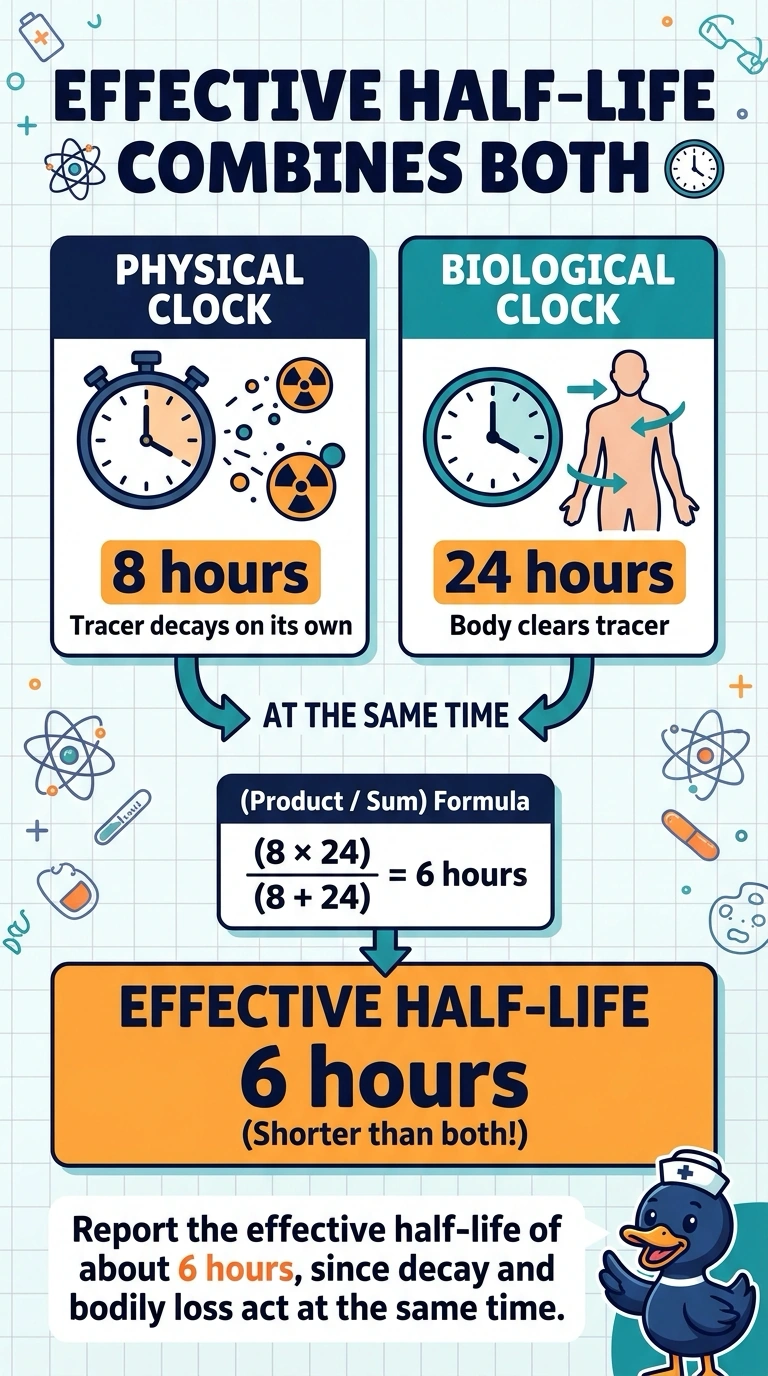
You've got it — the tracer is leaving by two routes at the same time, so it fades faster than either clock alone. The combined figure is the effective half-life, about six hours, and that's what whole-body activity actually follows. It's like two drains emptying one tub instead of taking turns.
Full Explanation
The reported time should be the effective half-life because radioactive decay and biological elimination occur concurrently, each reducing the activity remaining in the body. Their rates therefore add: 1/T_eff = 1/8 h + 1/24 h, giving T_eff = 6 h. The physical half-life alone correctly describes nuclear decay but omits the stated whole-body clearance, so it overestimates the time for total body activity to halve. The biological half-life alone describes bodily elimination but ignores radioactive decay, and likewise does not give the combined half-time. Using the shorter physical half-life as a quick estimate recognizes that decay is rapid, but it treats that process as dominant enough to stand in for the exact combined rate; with both processes specified, the approximation misses the faster effective loss. Exam caveat: biological half-life can vary with the tracer, patient, and measurement compartment, so use the biological value appropriate to the stated whole-body model rather than assuming a generic clearance time. Practical check: calculate the reciprocal-rate sum, confirm the effective half-life is shorter than either individual half-life, and verify that the requested quantity is total activity in the body rather than physical decay or biological clearance considered separately.