
A GM survey meter returns to service after its detector cable was reconnected during bench work. The battery check passes and background sits inside the control range, but the check-source response is lower than last month's reference value. Which test should qualified service personnel perform to confirm the tube's operating point is on its plateau?
Select an answer to reveal the explanation.
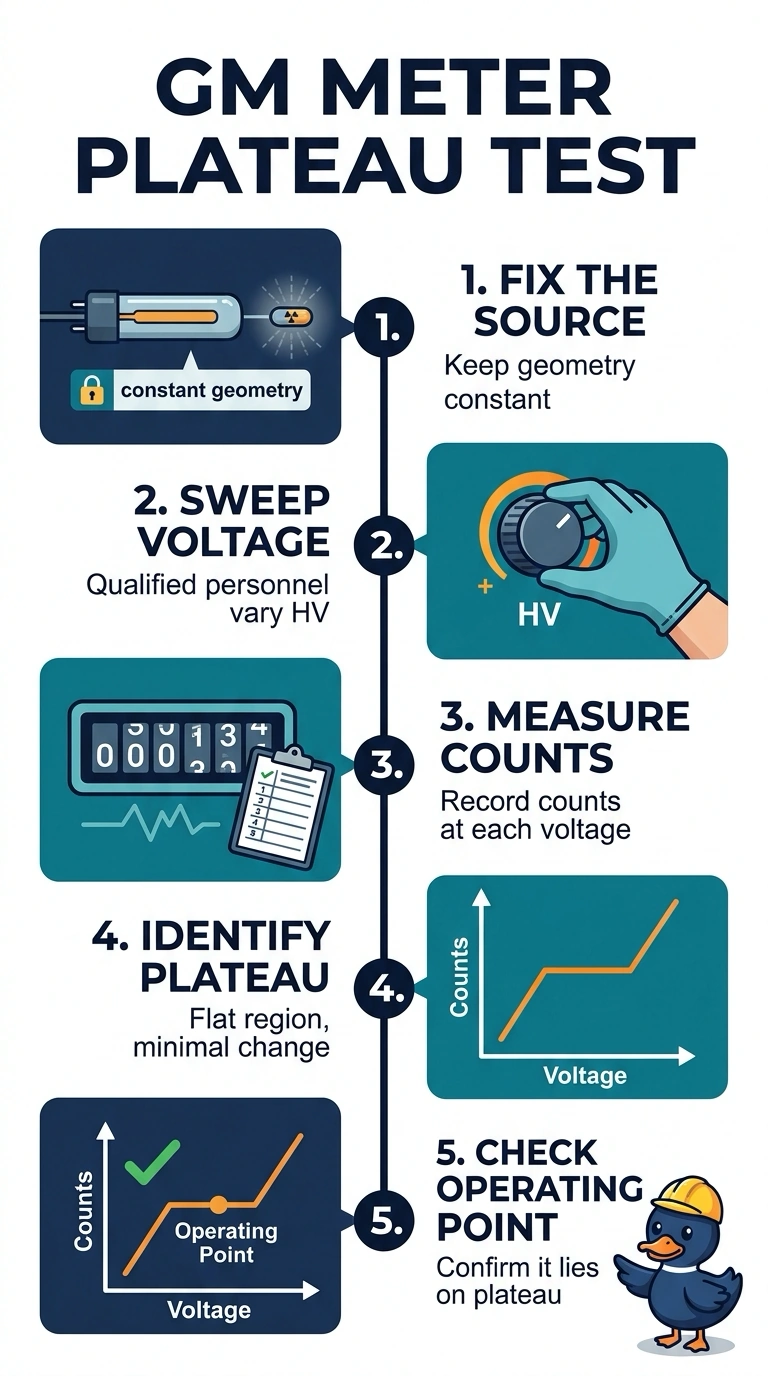
Short Explanation
Keep the check source fixed while qualified service personnel vary the high voltage and measure the counts across the plateau. It’s like checking a flat stretch of road: your count rate should stay fairly steady as the voltage changes.
Full Explanation
The correct test maps count rate against high voltage while the check source remains fixed. This reveals the plateau and shows whether the meter's operating point lies on it, rather than on a steep portion where small voltage changes can cause substantial response changes. Measuring high voltage under load is a useful service check, but agreement with the nominal setting alone does not establish that the tube is on its plateau; the tube's count response must be assessed across voltage. Repeating timed counts at the normal setting checks reproducibility and response against the reference, but it samples only one voltage and cannot locate the plateau or establish the operating point's position on it. Using an external supply can characterize the tube's plateau, but it bypasses the meter's own high-voltage supply, so it does not confirm that the instrument's operating point is on that plateau. Exam caveat: a low check-source response can result from causes other than an incorrect operating point, so the plateau test is diagnostic, not a complete calibration or fault-isolation procedure. Practical check: maintain reproducible source geometry and count long enough at each voltage to control statistical uncertainty, following the instrument's service procedure.