
A 60-year-old is discharged the same afternoon after oral iodine-131 treatment for hyperthyroidism. The discharge survey shows a low dose rate at one meter, but the patient will ride public transport home and lives with a family member. The dose estimate predicts that, without precautions, an individual could receive more than 0.1 rem but less than 0.5 rem. Written distance and contact instructions are expected to keep each individual's dose below 0.5 rem. Which release approach best meets the federal patient release rule and keeps others' exposure as low as reasonably achievable?
Select an answer to reveal the explanation.
Short Explanation
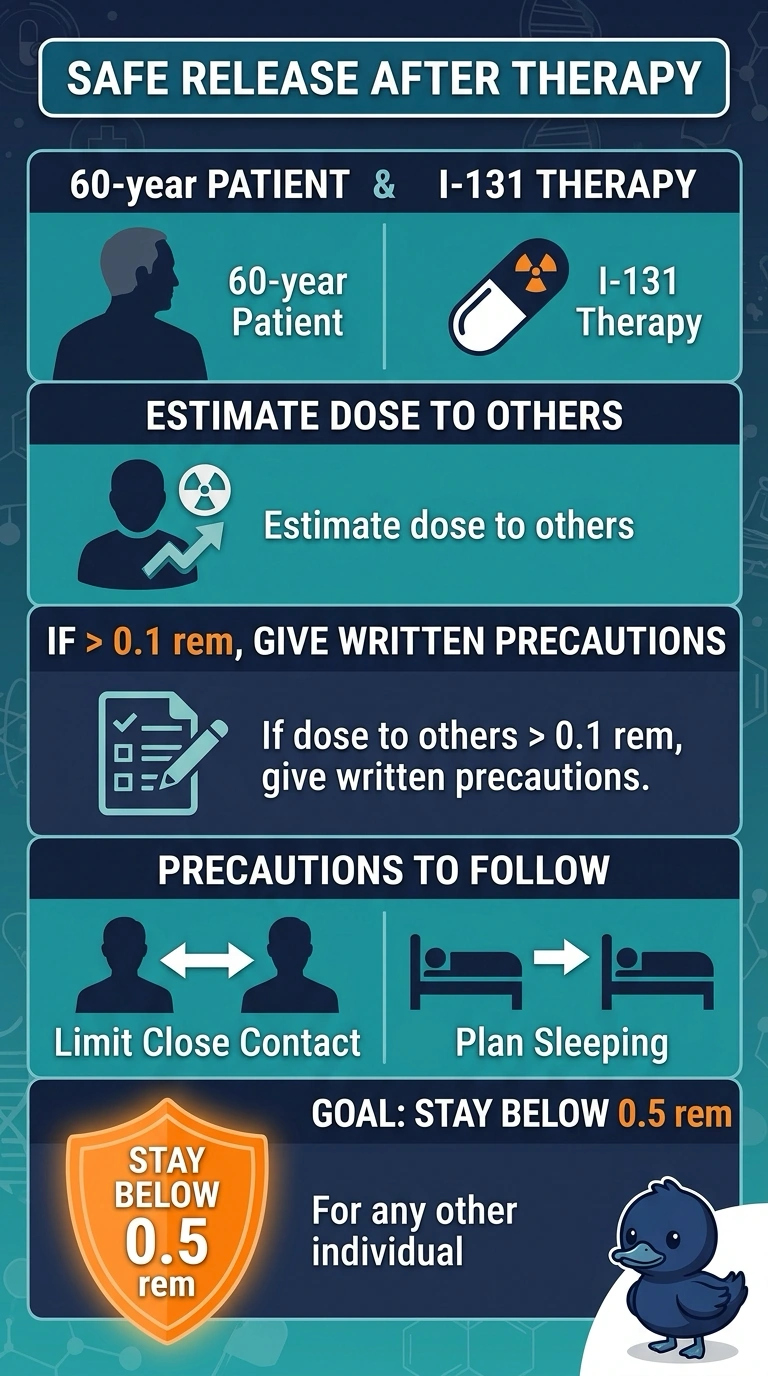
You can release the patient with written distance and contact instructions that keep each person’s dose below 0.5 rem; when the likely dose is above 0.1 rem, those instructions help keep exposure as low as reasonably achievable. A survey reading is just a snapshot—it doesn’t show the dose others may receive during the ride home or at home.
Full Explanation
Under the federal patient-release rule, release is permitted when the total effective dose equivalent to any other individual is not likely to exceed 0.5 rem. If the likely dose to another individual exceeds 0.1 rem, the regulation requires written instructions on actions to maintain that individual's dose as low as reasonably achievable. Here, the estimate exceeds 0.1 rem without precautions, so verbal instructions alone do not meet that requirement; the stated written precautions are expected to keep each individual's dose below 0.5 rem. Comparing the one-meter reading with an occupational limit does not establish the dose to family members or fellow passengers. An area survey against a public dose limit likewise does not establish the dose to a particular individual. A survey reading by itself cannot predict exposure during the bus ride or time spent with family.