
A technologist is drawing an afternoon Tc-99m sestamibi dose for a patient on the stress table. Policy requires the full label checked against the written order, the patient positively identified, and hand dose kept as low as possible during handling. Which dose-handling practice meets the label, identification, and shielding rules?
Select an answer to reveal the explanation.
Short Explanation
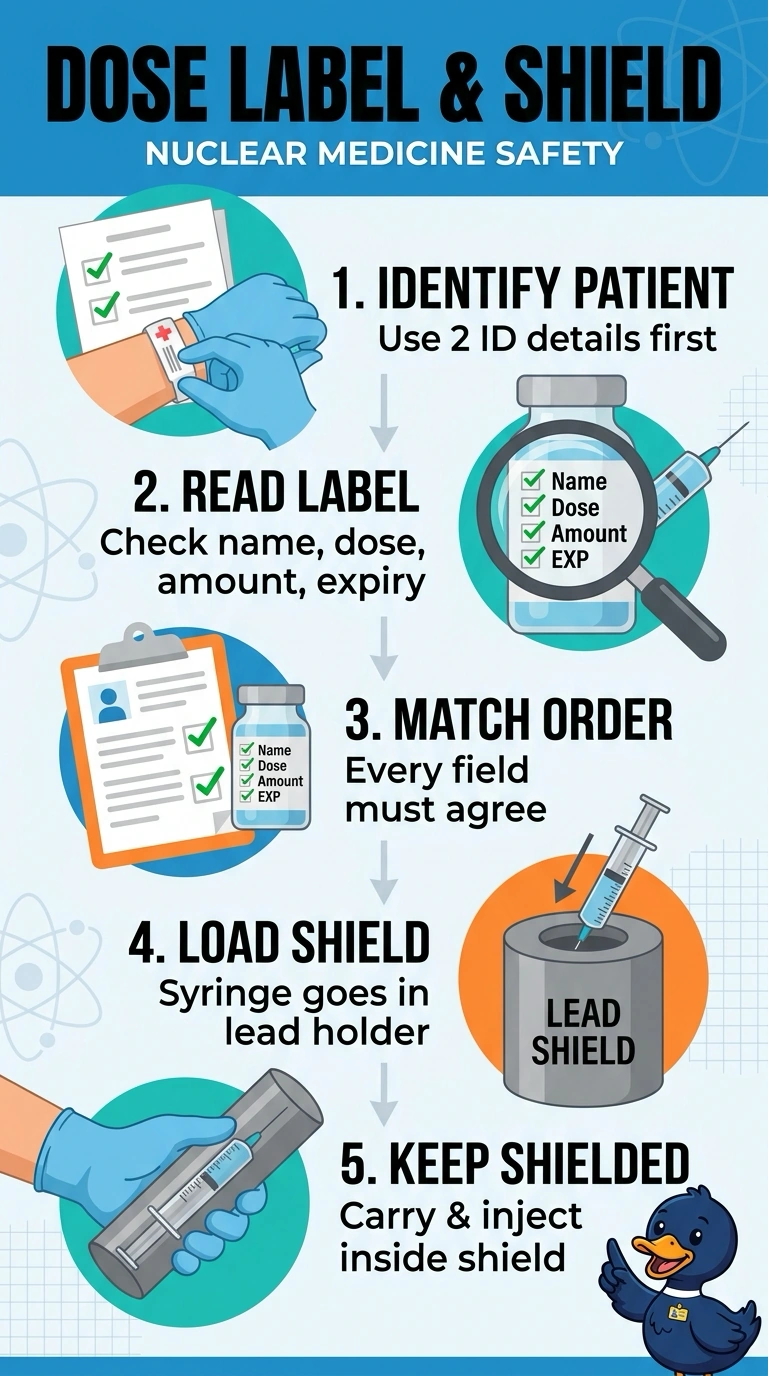
You check every label field against the order, identify the patient, and keep the dose inside a lead syringe shield the whole time it's in your hand. A bare syringe in your fingers is like an open flashlight, because the closer it sits and the longer you hold it, the more it reaches you. Syringe shielding helps keep your hand dose down.
Full Explanation
Reading the label in full and matching it to the written order helps prevent errors such as a wrong radiopharmaceutical, activity, volume, or expired dose, and identifying the patient at the bedside confirms that the correct label belongs to the person in front of you. Because Tc-99m emits gamma radiation that reaches your hand at close range, every second the syringe sits unshielded in your fingers adds to the extremity dose, so a lead syringe holder with a lead glass window reduces radiation reaching your hand while you still see the plunger and the fluid. Confirming identity and every label field while handling the syringe bare covers verification but leaves hand exposure uncontrolled. Shielding the syringe and checking only name, drug and activity skips the volume and expiration confirmation, which is exactly how an outdated or misfilled dose reaches the patient. Checking the full label while the syringe stays shielded never confirms the person, so a correct label can still be carried to the wrong patient. On the exam, shielding is judged by where your hands are during transport and injection rather than by what sits on the bench. As a practical check, ask yourself whether the syringe was ever in your hand without its shield.