
Your department is setting up a small room for aerosol ventilation imaging. The setup has a nebulizer, a mouthpiece and a length of tubing, and the room shares its return-air duct with the rest of the suite. The plan must keep released aerosol out of that shared air while the patient breathes. Which change to the delivery setup best contains the released aerosol?
Select an answer to reveal the explanation.
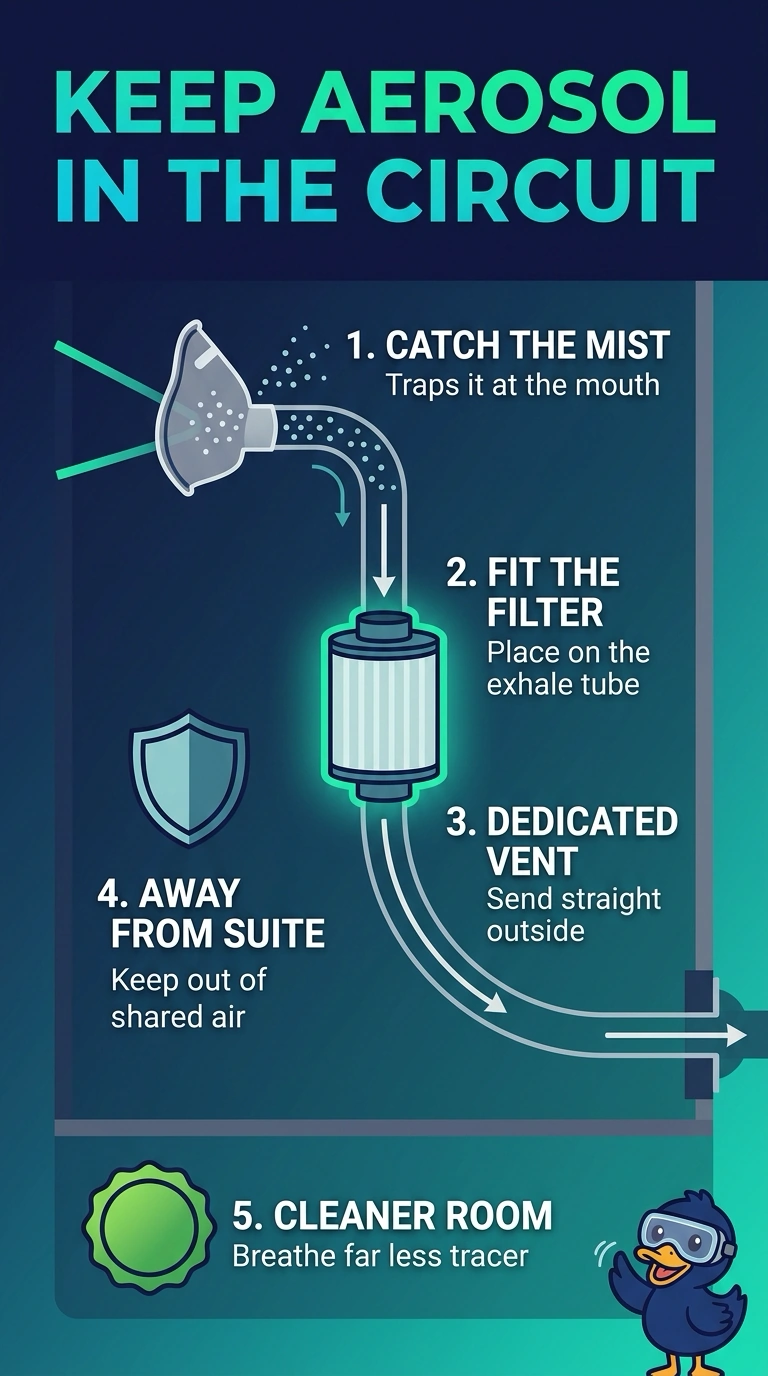
Short Explanation
Exactly — you've spotted the best place to catch released aerosol, right where it leaves the patient. A filter on the expiratory line traps it inside the circuit, and a dedicated exhaust carries anything else out of the suite. It's the same move as a fume hood that grabs fumes before the room ever sees them.
Full Explanation
The correct approach captures aerosol at the point where the patient exhales, filters it, and carries the filtered stream to a dedicated exhaust path. This addresses both parts of the scenario: aerosol is managed while the patient breathes, and the exhaust is kept separate from the suite’s shared return-air duct. A portable HEPA cleaner and increased room air changes can reduce airborne particle concentrations, but they dilute or recirculate room air rather than contain the patient’s exhaled stream before it enters the room and its shared return. An expiratory-line filter is useful source control, but discharging its outlet into the treatment room leaves that outlet dependent on room air handling instead of the specified dedicated exhaust path. A filtered inspiratory reservoir can support delivery of inhaled aerosol, but its conventional open expiratory vent releases exhaled aerosol into the room; filtering the supply side does not control that release. Exam caveat: distinguish source capture from room-air cleaning, and check whether a proposed exhaust route is actually separate from shared recirculation. In practice, verify filter compatibility and resistance, secure connections, and confirm that the dedicated exhaust is functioning as designed.