
A patient treated for lymphoma returns for restaging, and the order specifies metabolic imaging from the base of the skull to the upper legs, correction from the CT data, images after the standard uptake period, and the arms held above the head. Which acquisition plan best matches this restaging order?
Select an answer to reveal the explanation.
Short Explanation
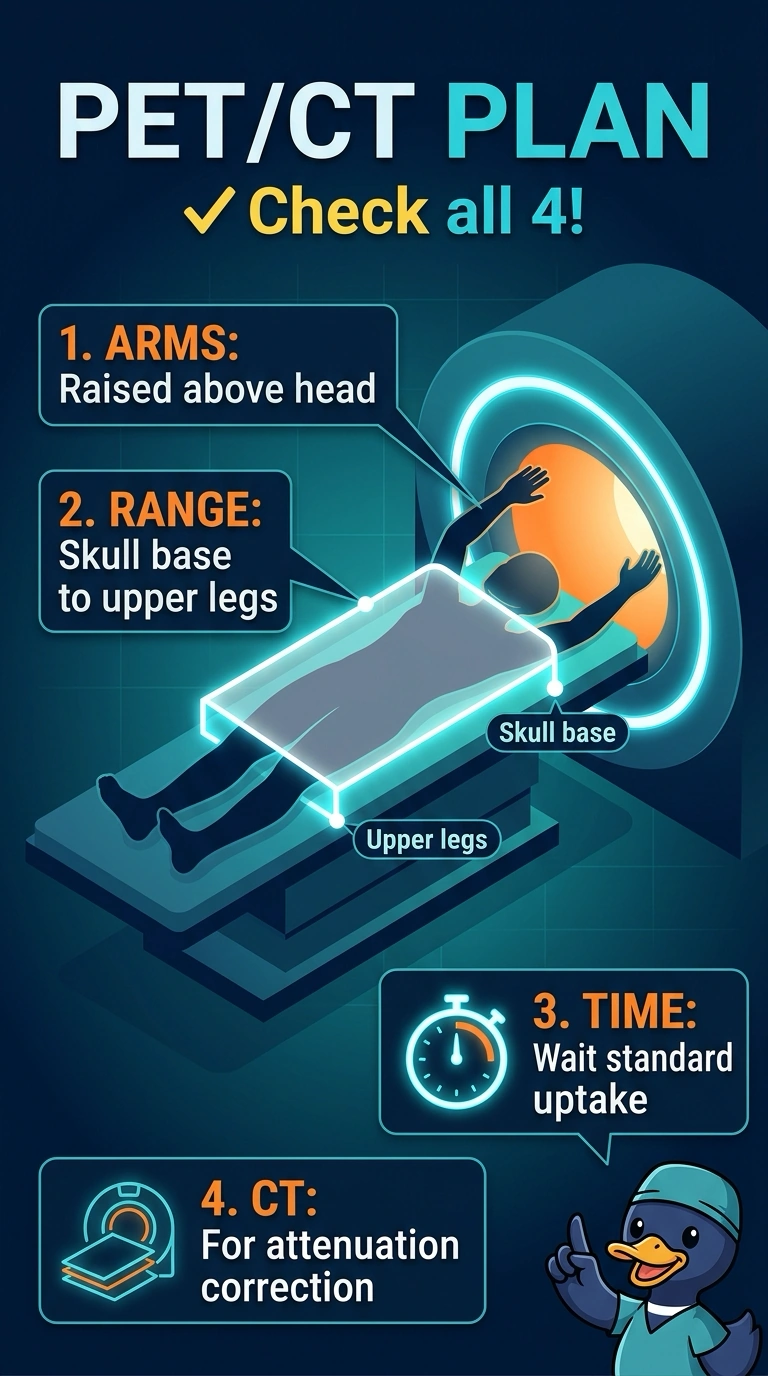
You’re looking for a plan that matches the requested range, timing, arm position, and correction method. CT-based attenuation correction is part of the order, so the matching plan acquires PET/CT from skull base to upper legs after the uptake period, with your arms raised.
Full Explanation
The matching plan follows all four specified elements: it covers the requested anatomy, acquires images after the standard uptake period, positions your arms above your head, and uses CT data for attenuation correction. Acquiring PET/CT before the standard uptake interval does not provide the requested standard post-uptake restaging acquisition, even though early or dynamic imaging can be useful for selected indications. Interpreting uncorrected PET images omits the requested CT-based correction, which compensates for photon loss through tissue; uncorrected images can be useful as a quality check but do not replace the specified correction. Keeping your arms at your sides does not match the requested positioning and may increase attenuation or artifacts across the trunk, although that position may be necessary if you cannot elevate your arms. Exam caveat: scan-range labels such as “skull base to thighs” can vary by protocol, so confirm the actual anatomical endpoints rather than relying on shorthand. Practical check: before acquisition, verify the planned range, uptake-time documentation, arm position, and that the reconstruction protocol applies CT-based attenuation correction.