
A 54-year-old with a well-differentiated neuroendocrine tumor of the small bowel is being evaluated for receptor-positive metastases before targeted therapy is considered. The plan must survey the entire body and give anatomic detail for small or indeterminate foci. Which imaging plan best maps this patient's receptor-positive disease?
Select an answer to reveal the explanation.
Short Explanation
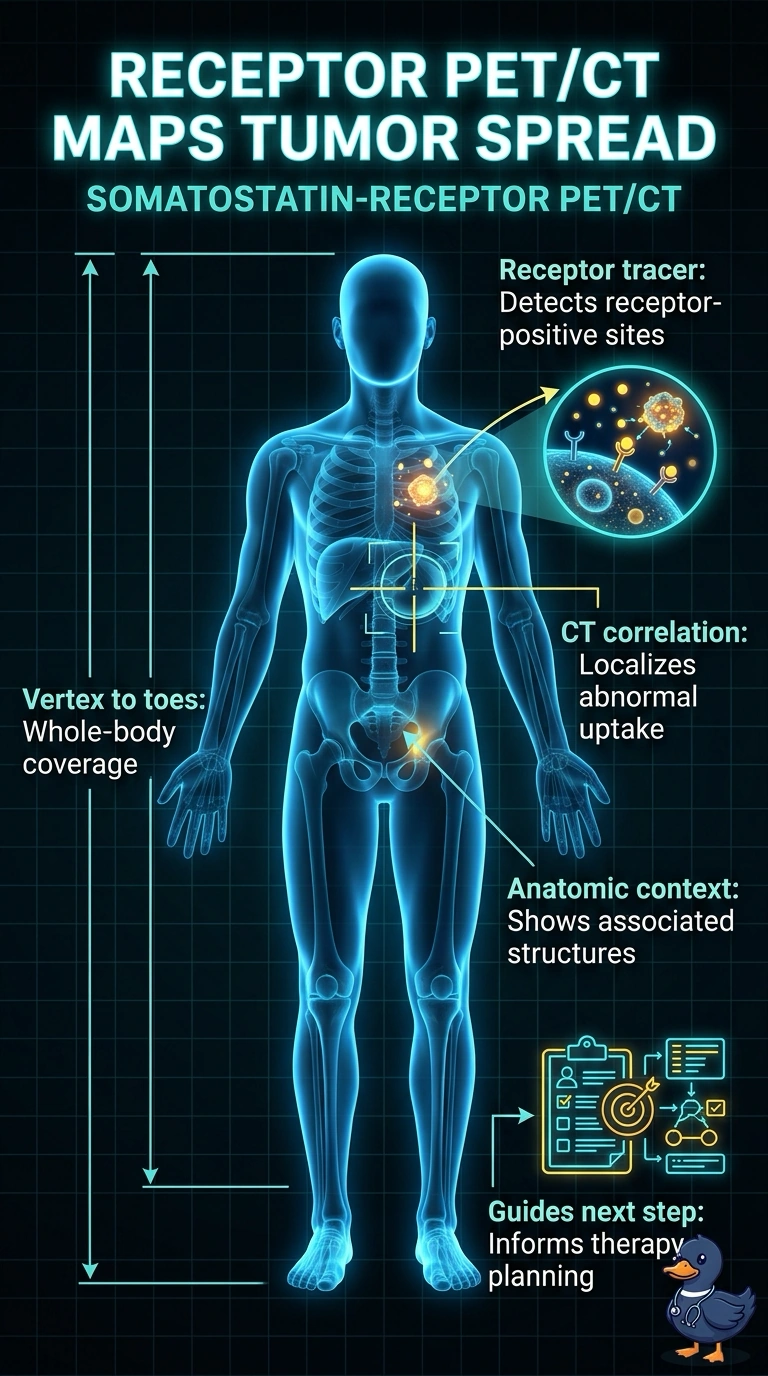
You need somatostatin-receptor PET/CT from vertex to toes to survey the whole body and use CT to pinpoint small or unclear receptor-positive foci. It’s like pairing a disease-finding signal with a detailed map, giving you the coverage and anatomic detail needed before targeted therapy.
Full Explanation
Somatostatin-receptor PET/CT is well suited to a well-differentiated small-bowel neuroendocrine tumor because it maps receptor-expressing disease across the body and pairs functional uptake with CT anatomy, helping localize small or indeterminate foci for staging and treatment planning. The vertex-to-toes acquisition is important here: a routine vertex-to-mid-thigh PET/CT can be appropriate for many oncologic surveys, but it may omit distal limb disease and therefore does not meet this case’s explicit whole-body coverage requirement. Planar receptor scintigraphy with targeted SPECT/CT is an established receptor-imaging approach and can provide useful localization where SPECT/CT is performed; however, planar imaging has lower spatial resolution, and targeted tomographic views do not provide detailed localization of every small or equivocal focus across the entire survey. FDG PET/CT offers whole-body coverage and CT localization, but FDG uptake reflects glucose metabolism rather than the receptor expression being assessed before receptor-targeted therapy; it may complement, not substitute for, receptor imaging. A caveat is that receptor expression and FDG avidity vary with tumor differentiation and lesion biology, so discordant findings can occur. In practice, verify the requested acquisition range and confirm that the study uses an appropriate somatostatin-receptor tracer and includes diagnostic-quality CT localization.