
Morning quality control on the PET/CT scanner shows the 511 keV photopeak from the reference source sitting above the expected energy window, and the flood image looks grainy rather than smooth. With an hour before the first patient, which PET calibration should be repeated to restore accurate counting?
Select an answer to reveal the explanation.
Short Explanation
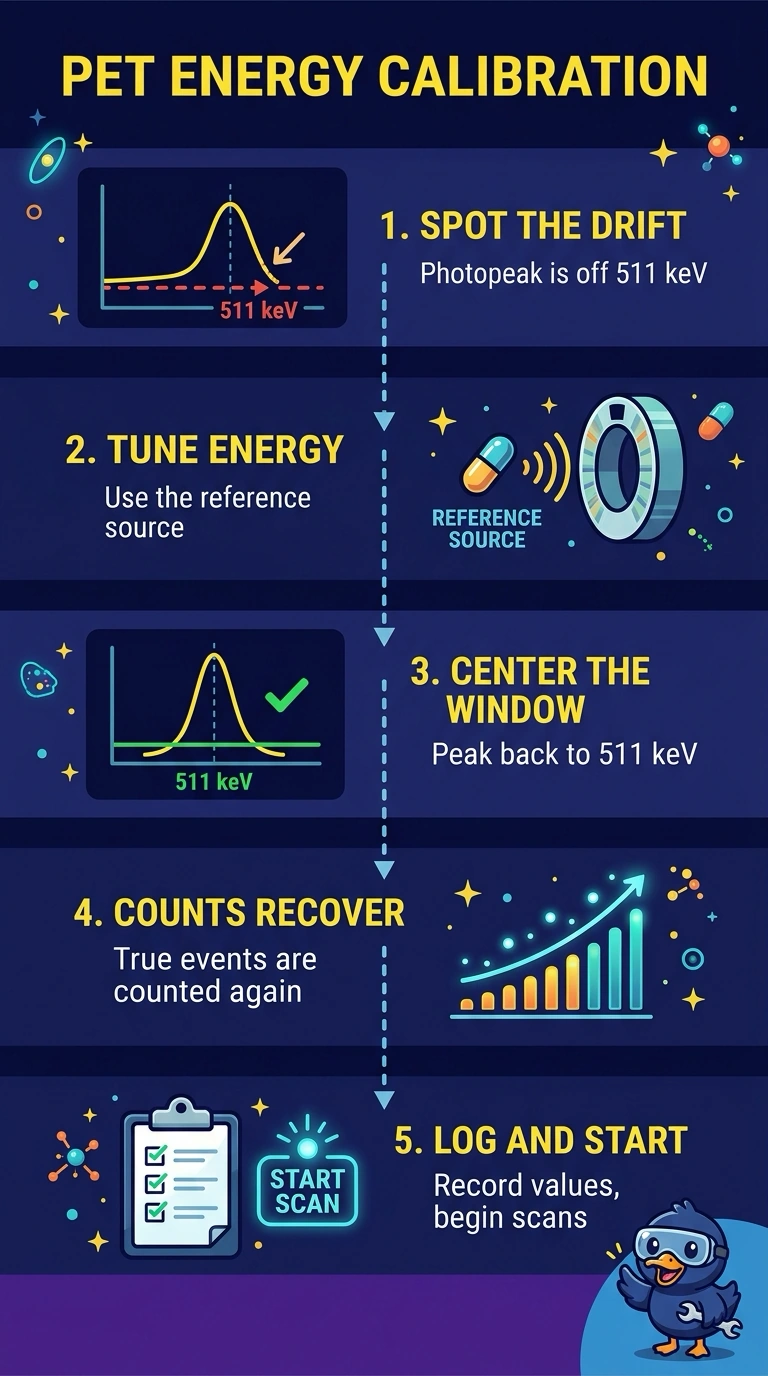
Detectors warm up and drift, so a photopeak that slides off 511 keV means valid events are landing outside the window. Re-running the energy calibration re-centers that window on the reference source, like retuning a radio that slipped off your station. You'd still finish the rest of daily QC afterward.
Full Explanation
PET detectors turn 511 keV annihilation photons into electrical pulses, and the scanner accepts only events that fall inside a window around 511 keV. When electronic gain drifts, the peak slides out of that window, true coincidences are discarded, and count density falls, which shows up as a mottled flood image. Re-running the energy calibration, also called peak or detector tuning, against the reference source pulls the peak back into place so counting statistics and scatter rejection return to normal, which is why it is the right response here. Repeating the daily uniformity acquisition measures how evenly detectors respond across the field; it documents smoothness but cannot move a misplaced peak, so it addresses a different question. The CT air calibration corrects Hounsfield values for tube and detector drift on the CT side and leaves the PET energy scale untouched. Refreshing normalization with a uniform-source scan fixes efficiency differences between detector blocks and supports quantitative accuracy over time, not an energy-window shift. Exam caveat: uniformity and tuning both sit on daily QC checklists, so read whether the complaint is image smoothness or peak position. Practical check: compare today's peak position and width with yesterday's log entry before you sign the sheet.