
A 54-year-old thyroid cancer patient returns for a whole-body survey five days after oral I-131 therapy. The shelf holds low-energy high-resolution, medium-energy general-purpose, and high-energy parallel-hole collimators, and the scan still needs enough counts to reveal small deposits. Which collimator and photopeak setting best fit this I-131 whole-body study?
Select an answer to reveal the explanation.
Short Explanation
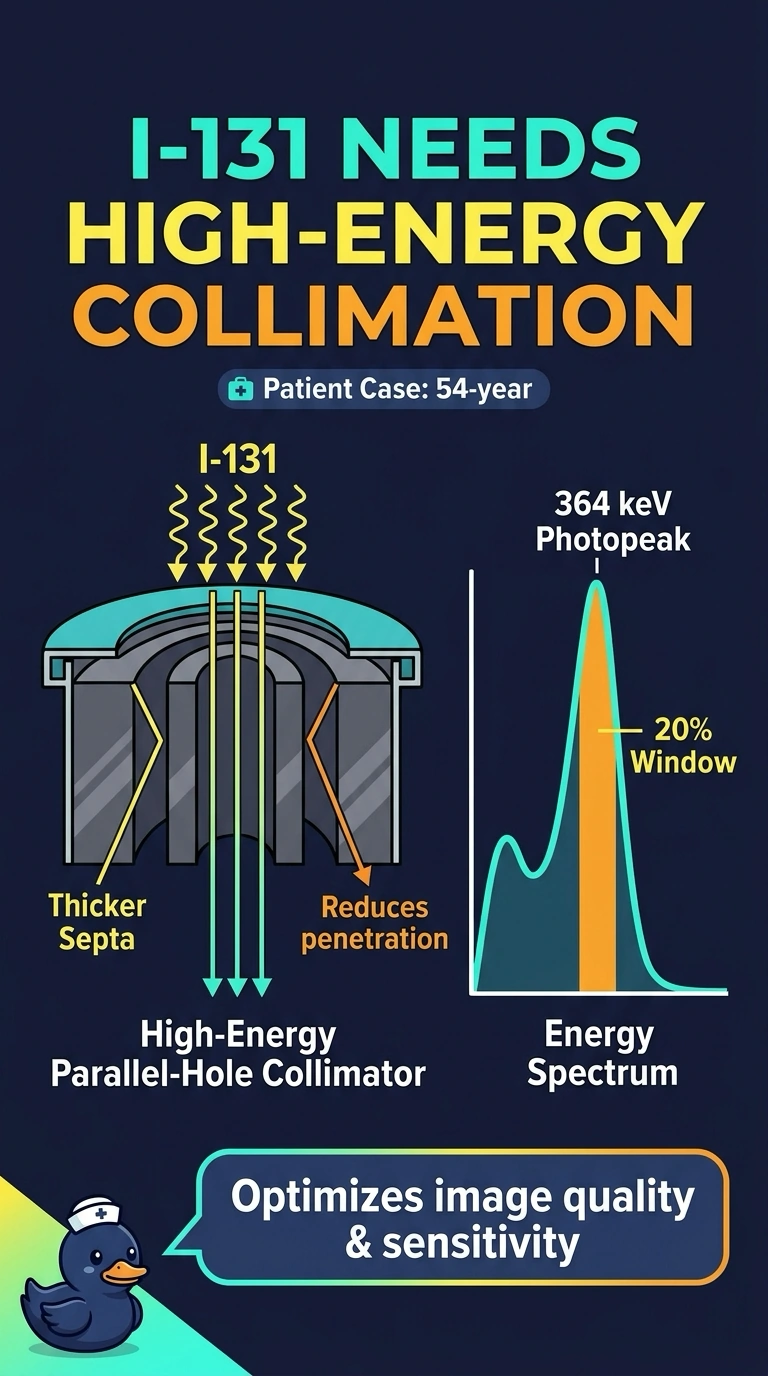
You’ll want the high-energy parallel-hole collimator with a 20% window centered on I-131’s 364 keV photopeak. Its thicker septa work like sturdy shields, limiting photon penetration while helping you collect enough counts to spot small deposits.
Full Explanation
Use the high-energy parallel-hole collimator with a 20% window centered on I-131’s principal 364-keV photopeak. Its thicker septa are designed to limit penetration by these high-energy photons, helping preserve spatial localization and image quality while the acquisition collects enough counts to detect small deposits. The medium-energy general-purpose approach is less suitable because its septa provide less protection against penetration at 364 keV, which can degrade the image. The low-energy high-resolution approach is still less appropriate: its thinner septa are not designed for this photon energy and allow greater septal penetration, potentially blurring deposits. Selecting a 10% window at 159 keV uses the wrong photopeak for this study; it does not target I-131’s principal 364-keV emission, so it is not the stated setup for the whole-body survey. Exam caveat: window widths and whole-body acquisition parameters can vary with camera and institutional protocol, so 20% is a reasonable setting here, not a universal rule. Practical check: confirm the radionuclide and verify that the camera’s energy window is centered on 364 keV and that the high-energy collimator is installed before scanning.