
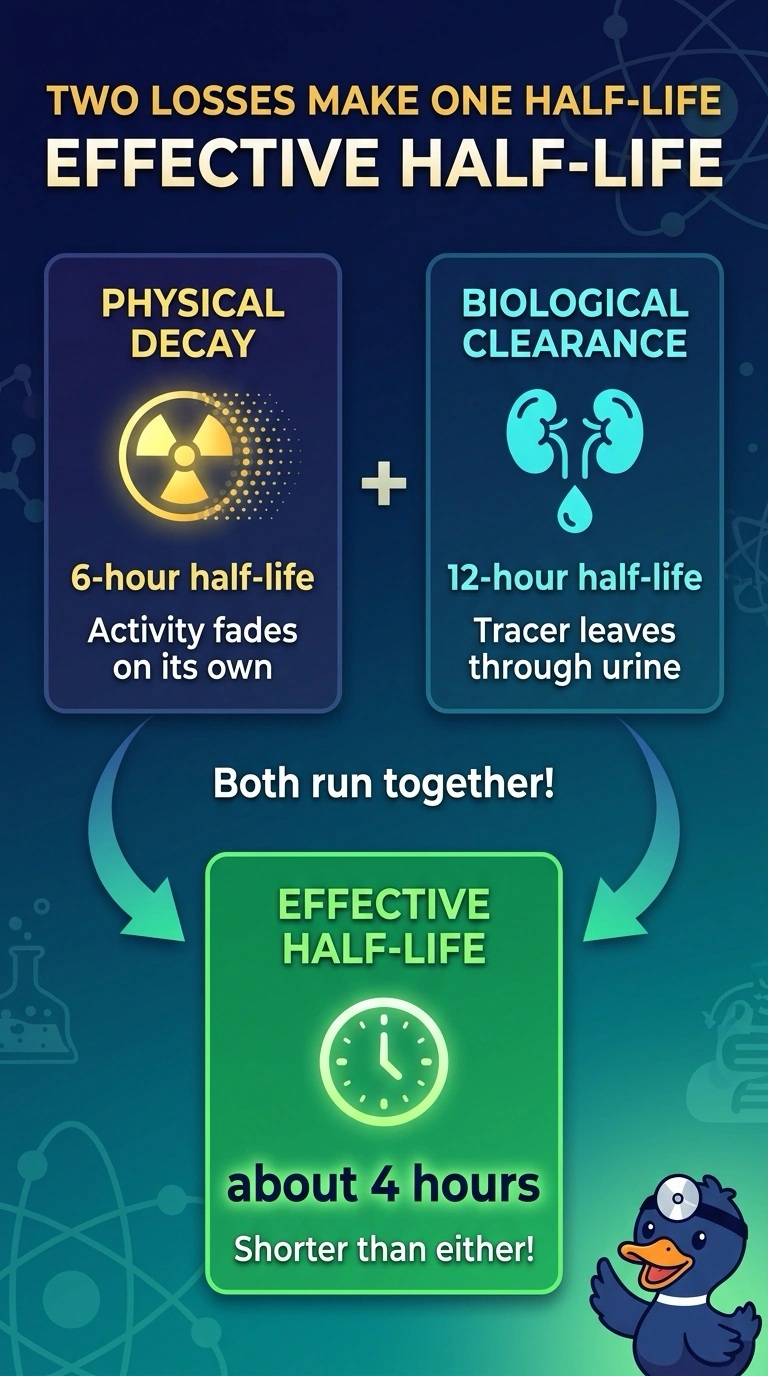
A patient asks how long the injected tracer will keep decaying after the appointment, and the team notes a 6-hour physical half-life with a 12-hour biological half-life for this agent. Which value best estimates how fast the total activity in the patient falls?
Select an answer to reveal the explanation.
Short Explanation
Exactly, you're counting both routes at once: effective half-life is the number that reflects them working together, so it lands below either single value. Two drains empty the same tub faster than one, and this is the combined flow rate.
Full Explanation
Physical decay and biological elimination are independent processes that happen at the same time, so their rates add rather than their times. Using 1/T = 1/Tphys + 1/Tbio for six hours and twelve hours gives a combined value of four hours, which is why the effective half-life is always shorter than either component. This combined figure is the one that predicts how much activity is actually left in the patient, because it counts both the atoms that have decayed and the atoms that have been excreted. Choosing the physical half-life alone treats the tracer as if it were sealed inside the body, so it leaves too much activity on the books once clearance is running. Choosing the biological half-life alone treats decay as irrelevant, and it likewise overestimates what remains. Averaging the two values assumes the processes take turns instead of running together, and it lands well above the true figure, so the arithmetic mean of independent rates is never the answer. The caveat is that this neat calculation assumes both processes are exponential and single compartment, so an agent with slow protein binding will not follow one clean value. A practical check: whenever both numbers are given, combine them reciprocally first and expect a result below the shorter one.