
A patient arrives for a vasodilator stress myocardial perfusion study having just finished a caffeinated drink, and the rhythm review shows frequent premature beats. The final data set has to support both perfusion images and gated volumes with an ejection fraction. Which combined preparation and gating plan keeps both parts of the study valid?
Select an answer to reveal the explanation.
Short Explanation
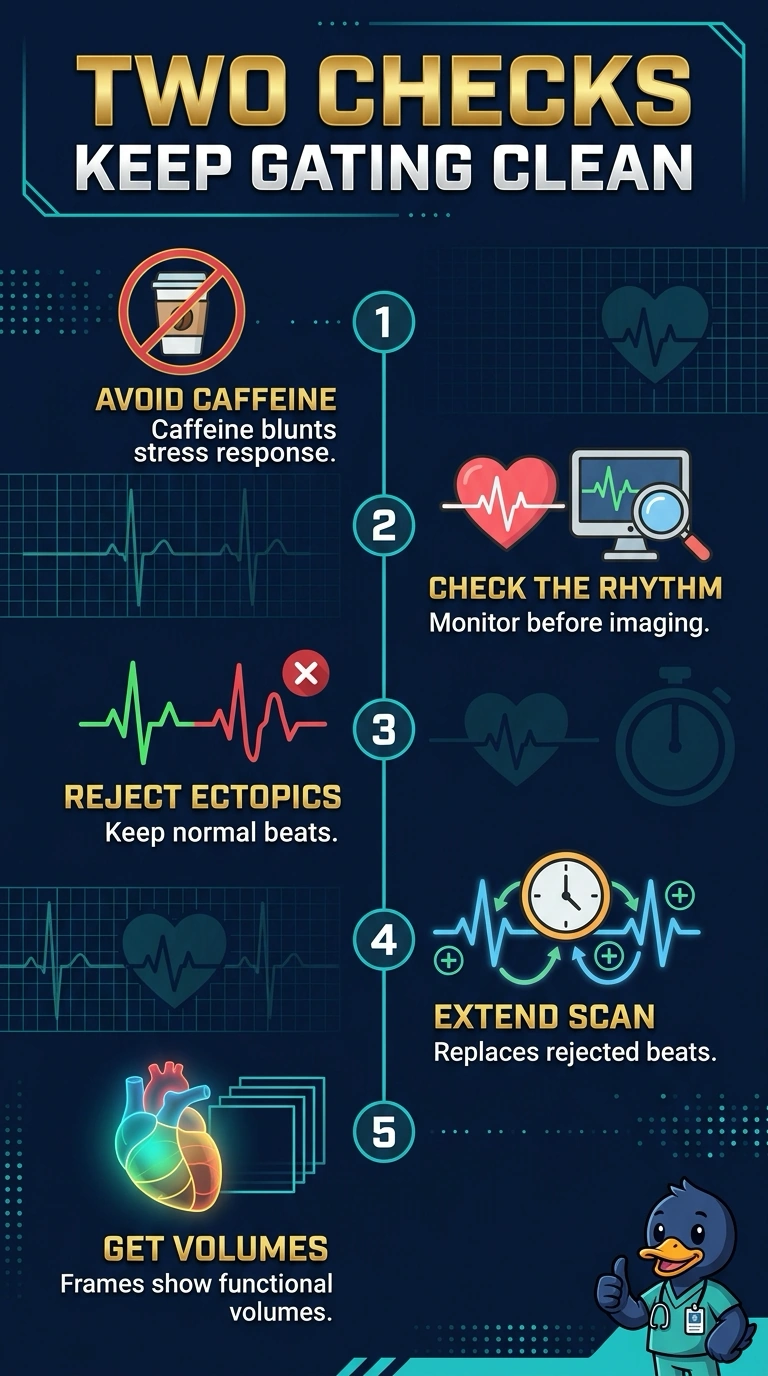
You’re protecting two parts of the study: caffeine can blunt the vasodilator stress response, and ectopic beats can distort gated measurements. Wait for the required caffeine interval, reject ectopic beats, and extend acquisition as needed to collect adequate counts.
Full Explanation
The valid plan waits until the required caffeine-abstinence interval is met, rejects ectopic beats, and extends acquisition as needed. Recent caffeine can blunt the coronary vasodilator response and reduce perfusion-imaging sensitivity; premature beats can distort gated volumes and ejection fraction. Rejecting those cycles protects the gated data, while extra acquisition time helps recover counts lost through beat rejection. Meeting the caffeine interval and rejecting ectopy but keeping a fixed acquisition time may leave too few counts for reliable images or gated measurements. Using a broad acceptance window that includes ectopic cycles can mix abnormal filling and contraction into the gated bins, biasing volumes and ejection fraction, even if acquisition is extended. A brief caffeine delay may not satisfy the required abstinence interval, so residual caffeine could still weaken the vasodilator response, despite appropriate ectopic-beat rejection and extra acquisition time. Exam caveat: required caffeine restrictions vary by stress agent and local protocol, so use the specified interval rather than assuming a universal duration. Practical check: confirm the timing and amount of the patient’s last caffeine exposure, review the rhythm and beat-acceptance settings, and verify that the acquisition plan supports both perfusion images and gated functional measurements.