
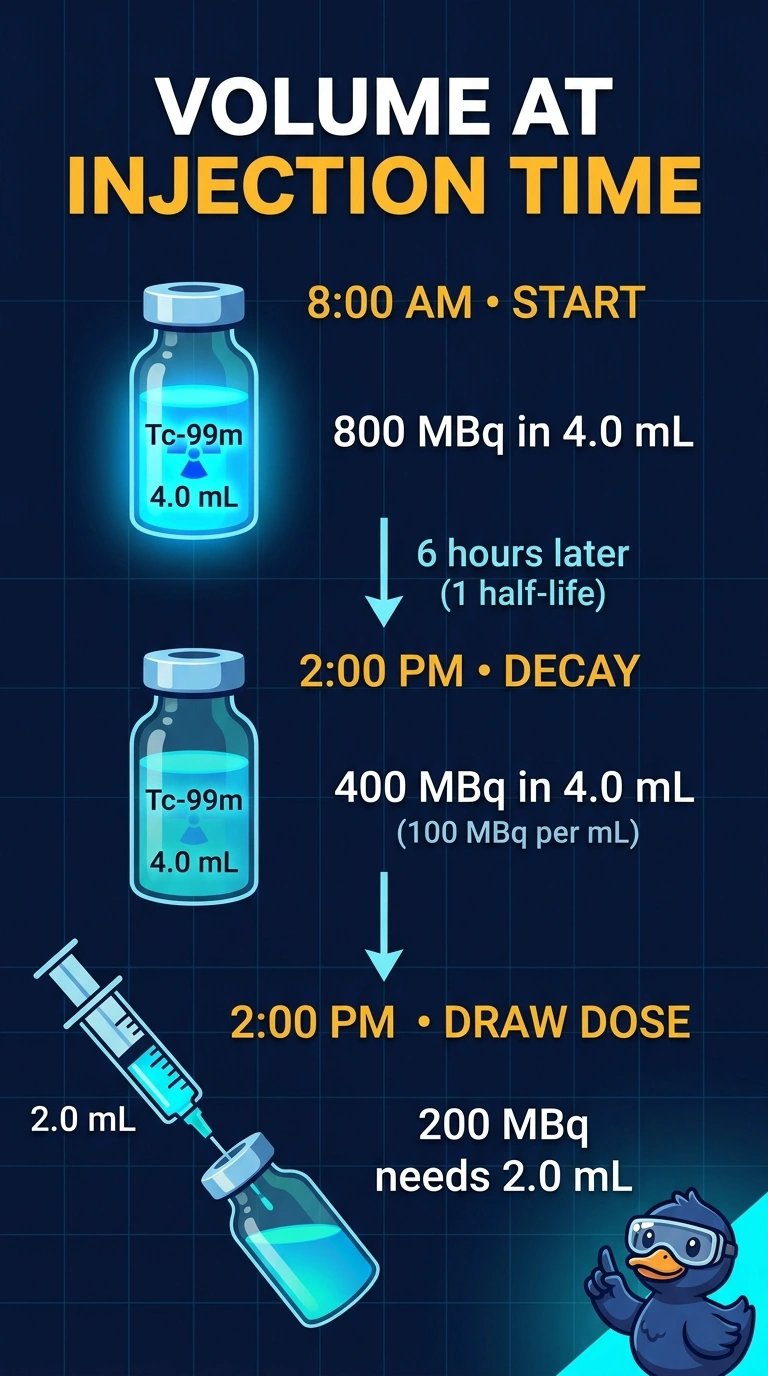
At 8:00 AM the dose calibrator shows a Tc-99m radiopharmaceutical vial containing 800 MBq in 4.0 mL. The prescription calls for 200 MBq to be injected at 2:00 PM, and Tc-99m has a physical half-life of about six hours. Which syringe volume drawn at 2:00 PM delivers the ordered activity?
Select an answer to reveal the explanation.
Short Explanation
By 2:00 PM, one half-life has passed, so the vial’s activity drops to about 400 MBq while the volume stays 4.0 mL. That’s like spreading the same amount of liquid over a weaker mix: at 100 MBq per mL, you’ll need 2.0 mL to deliver 200 MBq.
Full Explanation
The correct volume is 2.0 mL. Tc-99m undergoes radioactive decay, so after one physical half-life—six hours from 8:00 AM to 2:00 PM—the vial’s activity falls from 800 MBq to about 400 MBq. Assuming the liquid volume remains 4.0 mL, its concentration at administration is about 100 MBq/mL; therefore, 2.0 mL contains the prescribed 200 MBq. The calibration-time concentration approach is wrong because it uses 800 MBq ÷ 4.0 mL = 200 MBq/mL without accounting for decay; at 2:00 PM, 1.0 mL contains only about 100 MBq. The two-half-life approach incorrectly treats the six-hour interval as twelve hours: after two half-lives the vial would contain about 200 MBq total, or 50 MBq/mL, but only one half-life has elapsed here. The shielding-based approach also fails: shielding reduces exposure to radiation outside the syringe but does not stop Tc-99m atoms from decaying, so a 1.0 mL aliquot drawn at 8:00 AM falls from about 200 MBq to about 100 MBq by 2:00 PM. A key exam caveat is to distinguish elapsed time from the number of half-lives and apply decay to activity, not volume. As a practical check, measure the prepared syringe in an appropriately calibrated dose calibrator close to administration and verify that the activity matches the prescription.