
A young adult reports several episodes of maroon stools over two days, but a CT angiogram taken between episodes showed no active bleeding. The team also weighs a Meckel diverticulum scan. Which protocol plan best matches this slow, intermittent gastrointestinal bleeding?
Select an answer to reveal the explanation.
Short Explanation
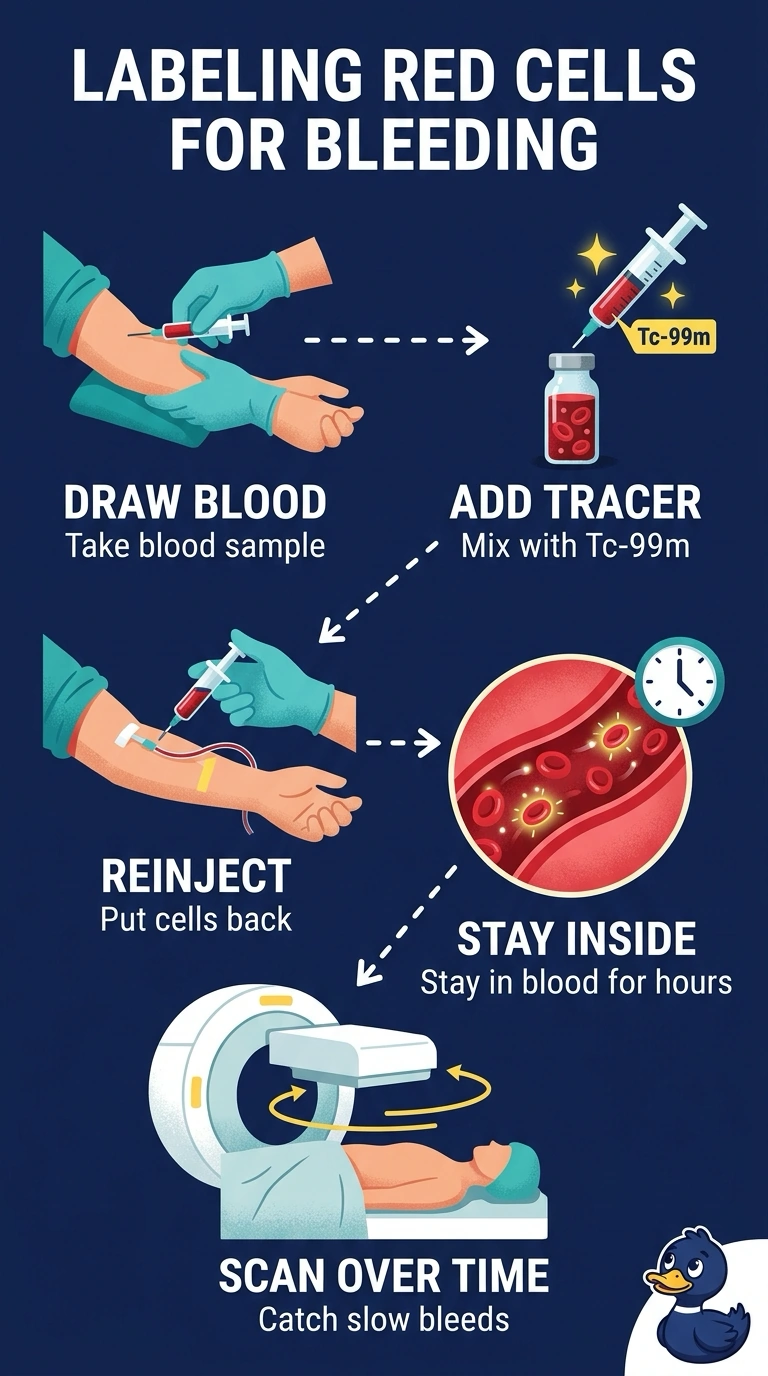
Labeled red cells stay in the bloodstream for hours, so you can continue imaging even when the bleeding pauses. That durability is what an intermittent leak demands of a labeled red blood cell study. A brief colloid acquisition may miss bleeding that pauses.
Full Explanation
Labeled red blood cells remain in the vascular space for hours, so the acquisition can be extended and repositioned until an intermittent bleed reveals itself. Sulfur colloid clears rapidly from the blood, limiting the imaging window; a pause in bleeding during that window may cause the study to miss the leak. A pertechnetate Meckel plan answers a different question by showing ectopic gastric mucosa in a diverticulum rather than locating active bleeding. Fasting may be used as preparation for a Meckel scan, but it neither extends the observation window nor keeps a tracer circulating for delayed imaging. Repositioning during a long study can help separate bowel activity from the kidneys and bladder. Confirm the labeling method and allow enough imaging time before the patient is injected.