
A cardiac PET program performs rest and stress myocardial perfusion imaging during one visit, with the stress injection about half an hour after the rest injection. The perfusion agent is rubidium-82, a positron emitter with a physical half-life of roughly 75 seconds. Which production method supplies a usable dose for both injections?
Select an answer to reveal the explanation.
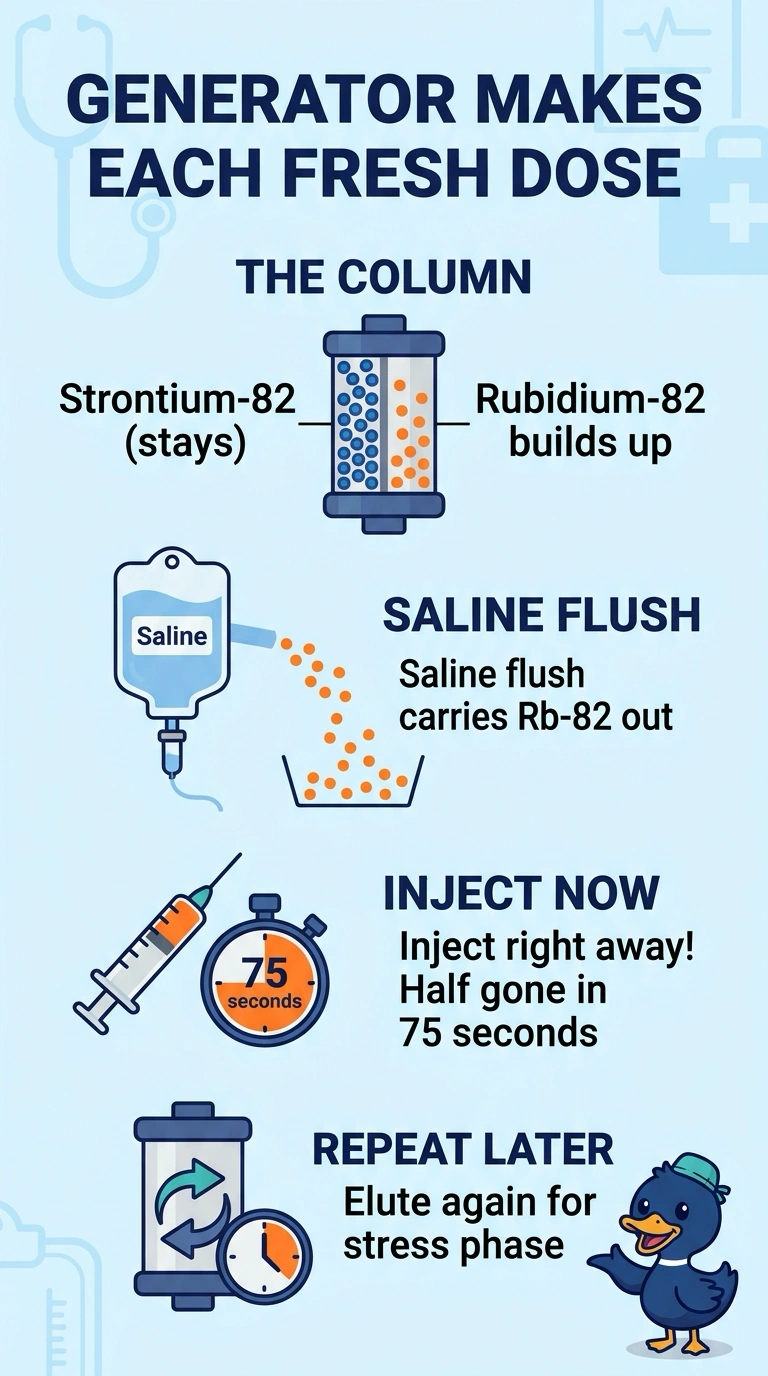
Short Explanation
A 75-second half-life rules out shipping and holding, so the generator is eluted beside the scanner just before each injection. It works like a soda fountain that pours a fresh glass only when you're ready.
Full Explanation
Rubidium-82 is the daughter of a strontium-82/rubidium-82 generator, where the longer-lived parent is held on a column and decays continuously, so a saline flush through that column delivers an injectable dose within seconds. Because the daughter's half-life is about 75 seconds, the activity has to be produced at the scanner for each injection, and a fresh elution shortly before the stress phase supplies the second dose from the same parent supply. A dose shipped from a distant facility would lose most of its activity during transport. Keeping one eluate for both injections fails on decay, because after only a few minutes almost none of a 75-second isotope remains. Eluting a technetium-99m generator delivers a single-photon tracer for SPECT rather than the positron emitter required for cardiac PET. Exam caveat: several short-lived PET agents rely on parent-daughter systems, so match each isotope to its production route instead of memorizing a product name. Practical check: log the elution time, injection time and calibrated activity, because decay continues in the syringe after the dose is drawn.