
Tc-99m sulfur colloid for a liver-spleen study passes chromatography for radiochemical purity and passes visual inspection, yet the measured particle size falls outside the stated range. Why does the particle size result alone make this preparation unusable?
Select an answer to reveal the explanation.
Short Explanation
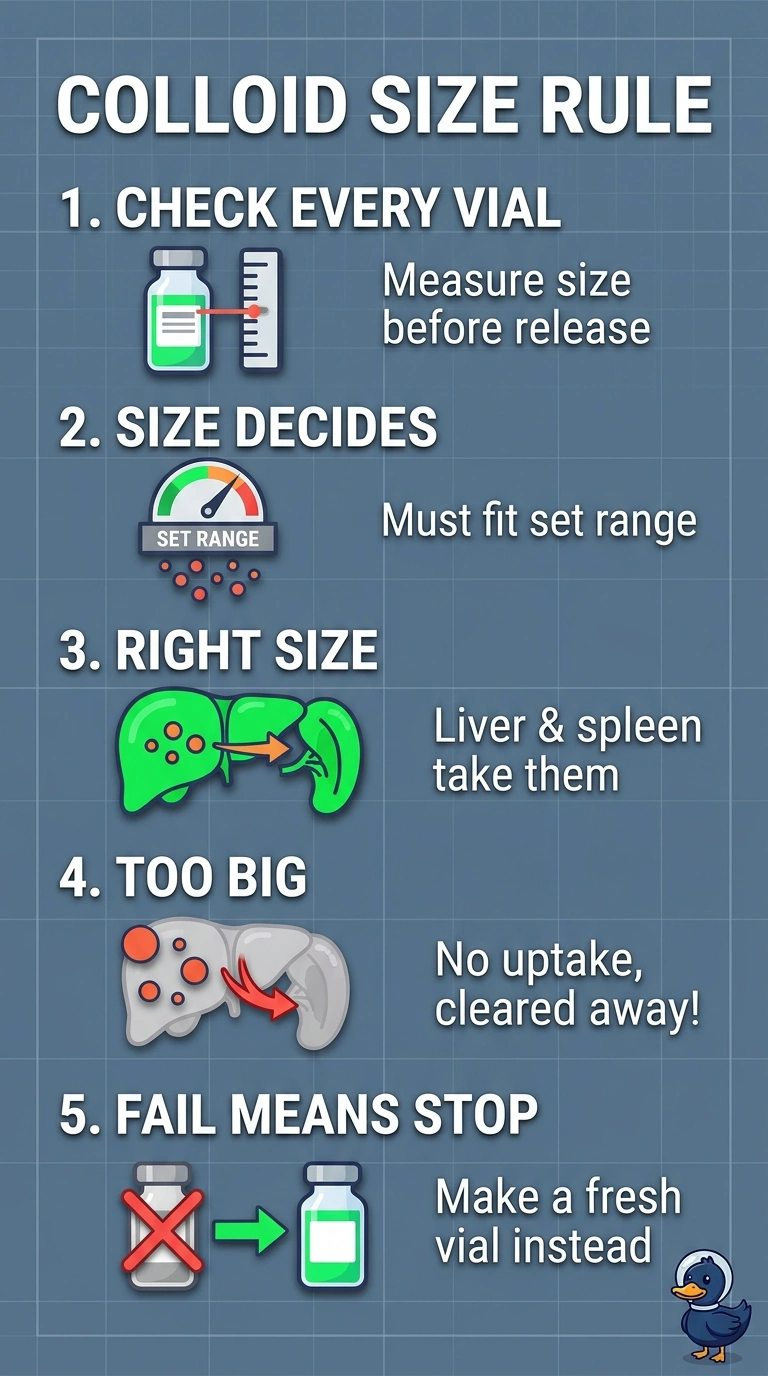
You can pass purity and appearance and still fail the test that decides where the colloid travels, because the liver and spleen can't take up particles of the wrong size. It's like a package too big for the delivery chute: it never arrives. The deciding release criterion is particle size.
Full Explanation
Particle size is the physical handle that decides biodistribution for Tc-99m sulfur colloid: material inside the specified range is phagocytosed by Kupffer cells in the liver and macrophages in the spleen, while particles that are too large are trapped at the injection site or in the lungs, so the target organs never accumulate enough activity to image. Release testing works as a set of gates rather than a scoreboard, so purity, particle size and clarity must all pass before a dose is drawn. Treating radiochemical purity as the controlling criterion follows the purity-first habit, yet chromatography reports only the chemical form of the tracer and says nothing about particle size. Adjusting the injected volume follows the dose-minimization habit, since fewer milliliters do mean fewer particles, but volume changes how many are given rather than how big each one is, so distribution stays wrong. Filing the measurement as a deviation follows the documentation habit, yet a clear vial shows only what the eye can see and cannot replace a failed measurement. Exam caveat: the acceptance range and test method come from manufacturer specifications and department procedure, so work from the stated limit rather than a memorized number. Practical check: quarantine the vial, record the failing parameter, and prepare a fresh kit before you call the patient.