
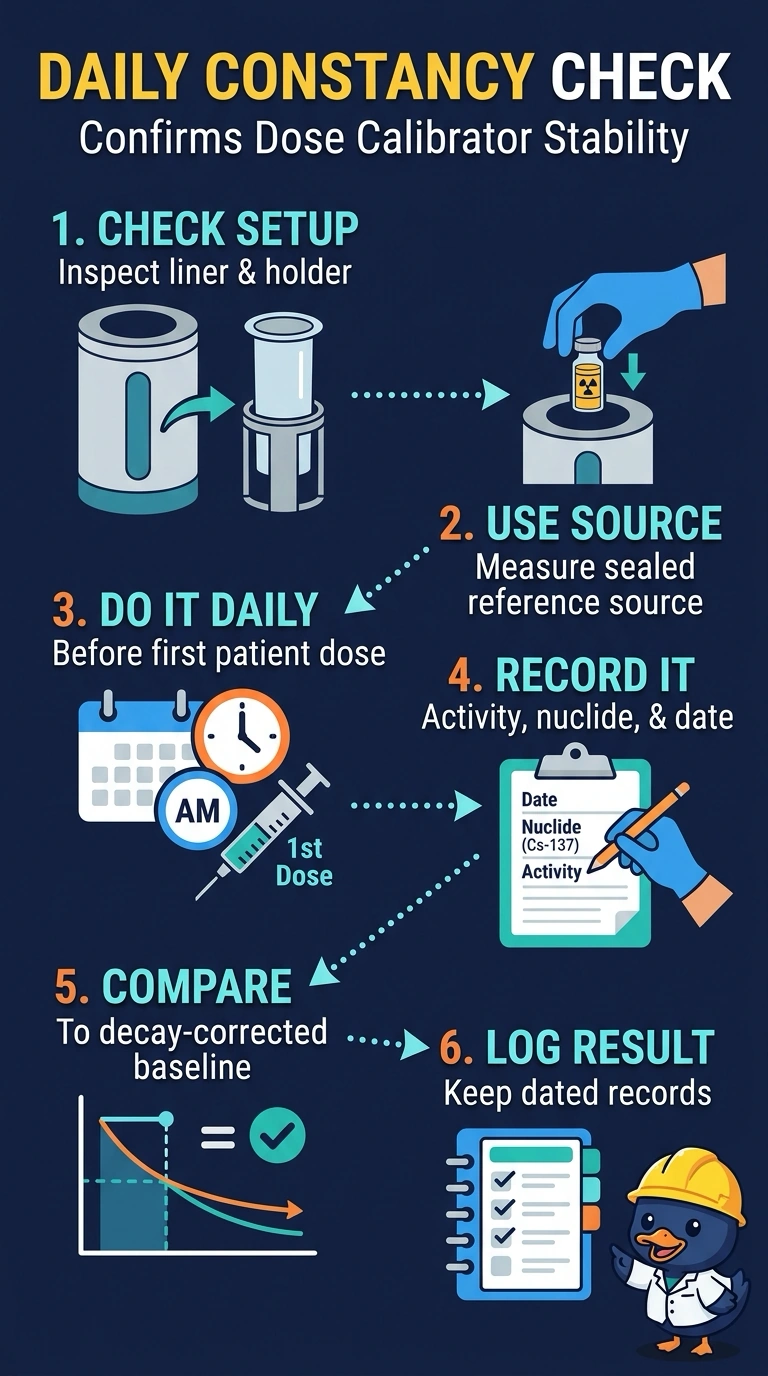
Each morning at a busy hospital, before any patient doses are drawn, the technologist measures the same sealed reference source in the dose calibrator and compares today's reading with its decay-corrected baseline. Which quality control test does this routine represent?
Select an answer to reveal the explanation.
Short Explanation
Measuring that same sealed source every morning is the giveaway: you are watching for drift in the instrument's response. This daily constancy check helps catch a change before a patient dose is drawn. It's the bathroom scale you step on each morning to confirm it still reads your usual weight.
Full Explanation
Constancy is the repeated measurement of one sealed reference source against its decay-corrected baseline, and its purpose is to check that the calibrator's response remains stable from day to day. A drifting result can arise from the electronics, the chamber, the liner or the measuring geometry rather than from a patient's dose. Accuracy testing compares measured activity with known activity using at least two radionuclides; it is performed upon installation and at least annually under NRC requirements. Linearity testing spans a wide range of activities, often by letting a source decay, to show that the response stays proportional from low to high readings. Geometry testing evaluates how container and volume differences affect readings, and is performed upon installation and after relevant changes to the measurement setup. An out-of-range morning value can result from something as simple as the wrong nuclide setting or a missing liner, so recheck the setup before calling for service. As a practical check, read the same source twice before accepting an unusual result.