
A radiopharmacy technician prepares a dose of a therapeutic agent that is a pure beta emitter with no usable gamma emission. While the dose sits in its shielded container, a survey meter records penetrating photons coming from the shield itself. Which physical interaction between the beta particle and the shield produces those photons?
Select an answer to reveal the explanation.
Short Explanation
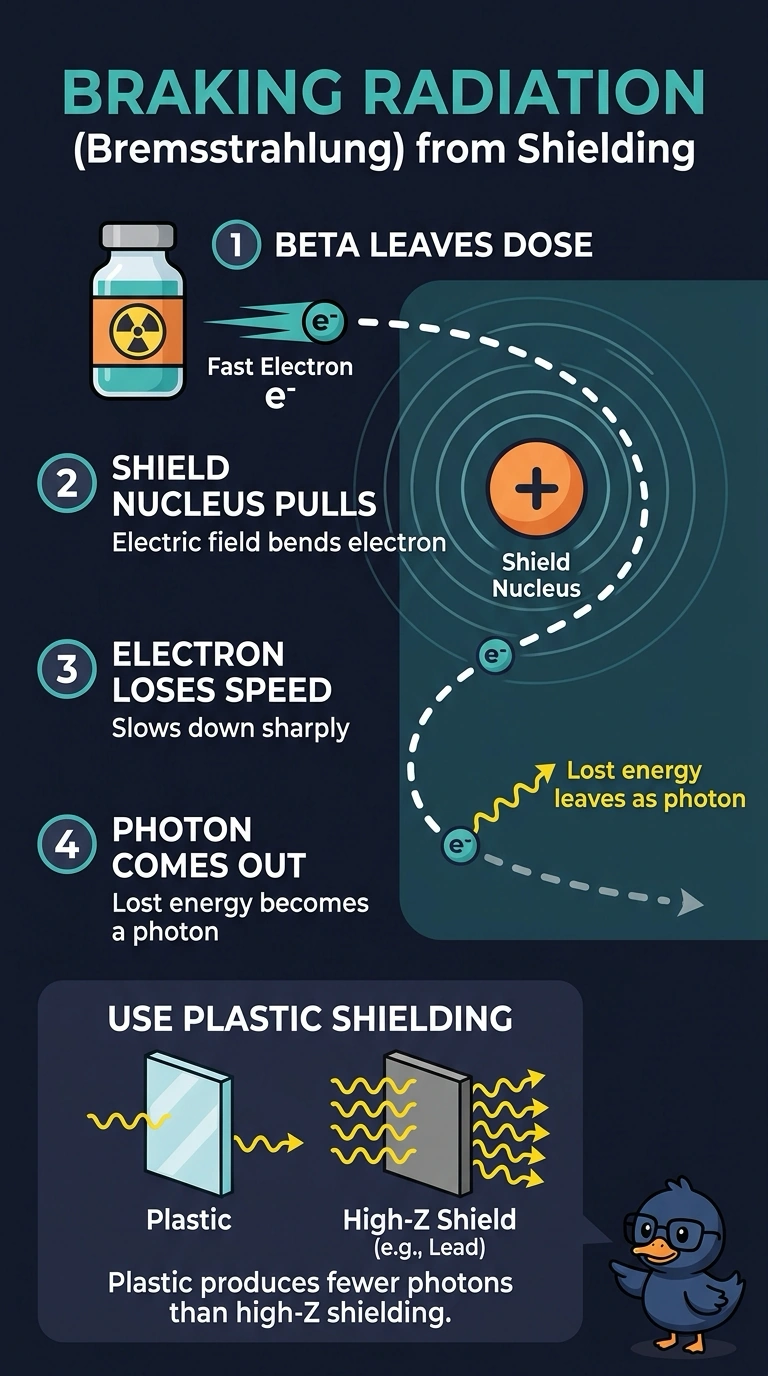
When your fast beta particle passes near nuclei in the shield, their electric fields slow and deflect it, releasing penetrating photons; this process is bremsstrahlung. It’s like a car braking and giving up motion energy—here, that lost energy comes out as radiation.
Full Explanation
Bremsstrahlung, literally braking radiation, is created when a charged particle is deflected and decelerated by the electric field of a nucleus, and the kinetic energy it loses leaves as a photon. A shield of high atomic number is especially efficient at converting beta energy into photons, so the container shield can produce the photons the survey meter reads. Internal conversion is a nuclear de-excitation process that ejects an orbital electron rather than producing the penetrating photon described here. Auger emission likewise produces electrons after an inner-shell vacancy is filled; those electrons are not penetrating photons, although they can escape an atom and be detected if they reach a detector. Gamma emission from a metastable daughter would originate in the source, not in the shield. Exam caveat: the same term applies to any charged particle slowed in matter, not only beta emitters. Practical check: survey the container with the correct probe and use low-atomic-number shielding, such as plastic, to reduce bremsstrahlung production compared with high-atomic-number shielding.