
A patient with breast cancer in the upper outer quadrant is booked for sentinel lymph node mapping and surgery on the same morning, and no nodes are palpable. The surgeon wants the lymphatic channels traced to the first draining node and the site marked on the skin before the incision. Which lymphoscintigraphy plan best fits this surgical timing?
Select an answer to reveal the explanation.
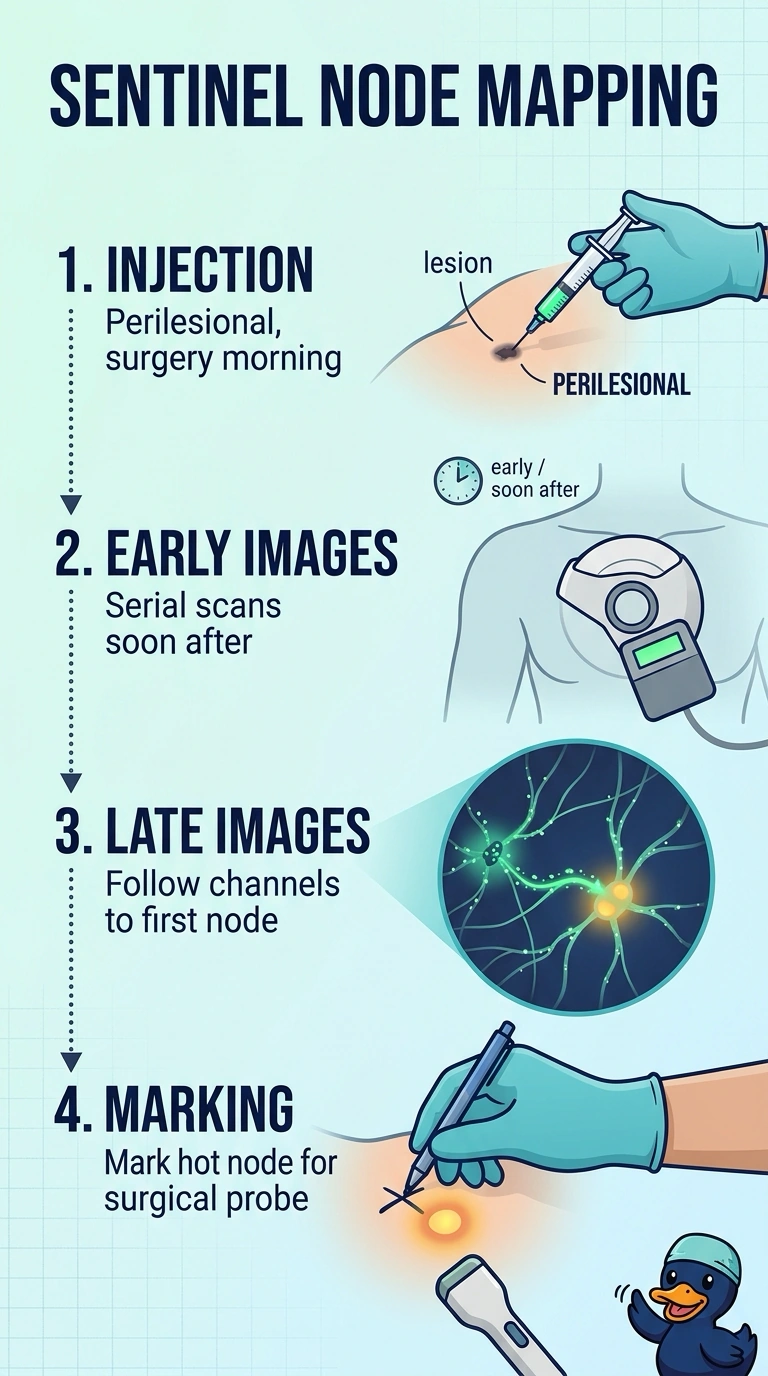
Short Explanation
You’ll inject tracer around the lesion on surgery day, take serial images starting early, and mark the node’s skin location before the incision. That mark works like a map pin for the surgeon, guiding them to the sentinel node—the first node to drain the area.
Full Explanation
The stated plan best matches the operative workflow: perilesional tracer injection on the day of surgery allows lymphatic drainage to be followed from early uptake, helping identify the first draining node rather than merely a later site of tracer accumulation. Marking the node projection on the skin provides a visible guide for incision planning when examination reveals no palpable nodes. Injecting the afternoon before surgery can be an established protocol when timing or local practice calls for preoperative imaging, and serial early images plus a skin mark may still characterize drainage; however, it does not meet the specified same-day timing. Relying on gamma-probe localization after same-day serial imaging is also a common surgical approach and can guide node retrieval, but it omits the explicitly requested pre-incision skin mark. A delayed static image may show where a node has accumulated tracer, and marking that location is useful, but it does not document early lymphatic channels or establish the first draining node as well as serial early imaging. An exam caveat is that injection site, tracer, and imaging schedule vary with the institution’s protocol and the operation planned. In practice, confirm the injection-to-imaging interval and coordinate the marked skin projection with the surgeon before incision.