
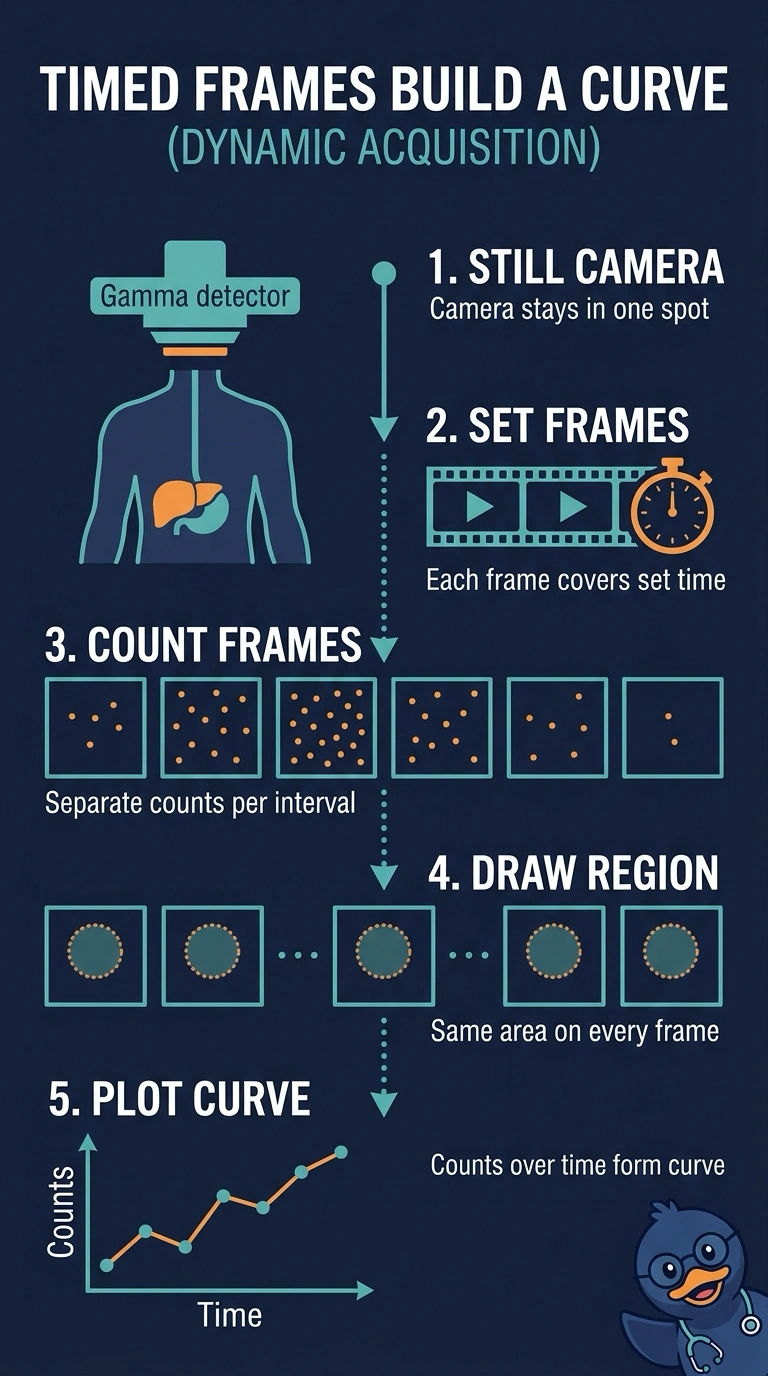
A physician orders a 20-minute study after tracer administration so that a region of interest over one organ can be plotted as a time-activity curve. The camera must stay in a single position, images must be captured in successive short intervals, and the counts from each interval must remain separate for later analysis. Which gamma camera acquisition mode produces the data set the team needs?
Select an answer to reveal the explanation.
Short Explanation
You're building a movie rather than a snapshot, because the team needs counts across clock time. A dynamic acquisition holds the camera still and slices the study into consecutive frames. It works like timing each lap with one stopwatch instead of only photographing the finish line.
Full Explanation
A dynamic acquisition is organized around elapsed time: the camera holds one fixed position while detected events are sorted into consecutive frames, so the counts in each frame can be plotted against time and turned into the region-of-interest time-activity curve the physician asked for. A static planar image folds the acquisition into a single image and does not preserve separate counts for successive intervals, so the requested curve cannot be recovered from it. A gated acquisition sorts events according to the patient's cardiac cycle rather than successive intervals of elapsed time, making it unsuitable for this requested study. A conventional SPECT acquisition rotates the camera around the patient for three-dimensional reconstruction, so it does not meet the fixed-position requirement. On the exam, remember that gating organizes data by cardiac phase while dynamic imaging organizes data into frames over elapsed time. A practical check before you start is confirming the frame duration, total study time and matrix so each frame carries enough counts for a smooth curve.