
A nuclear medicine department uses absorbent pads, gloves and syringes with a short-lived imaging agent, plus one long-lived sealed reference source that stays in the lab. The safety officer requires each item to leave by the route matching its half-life, with release documented before disposal. Which disposal route applies to the absorbent pads, gloves and syringes?
Select an answer to reveal the explanation.
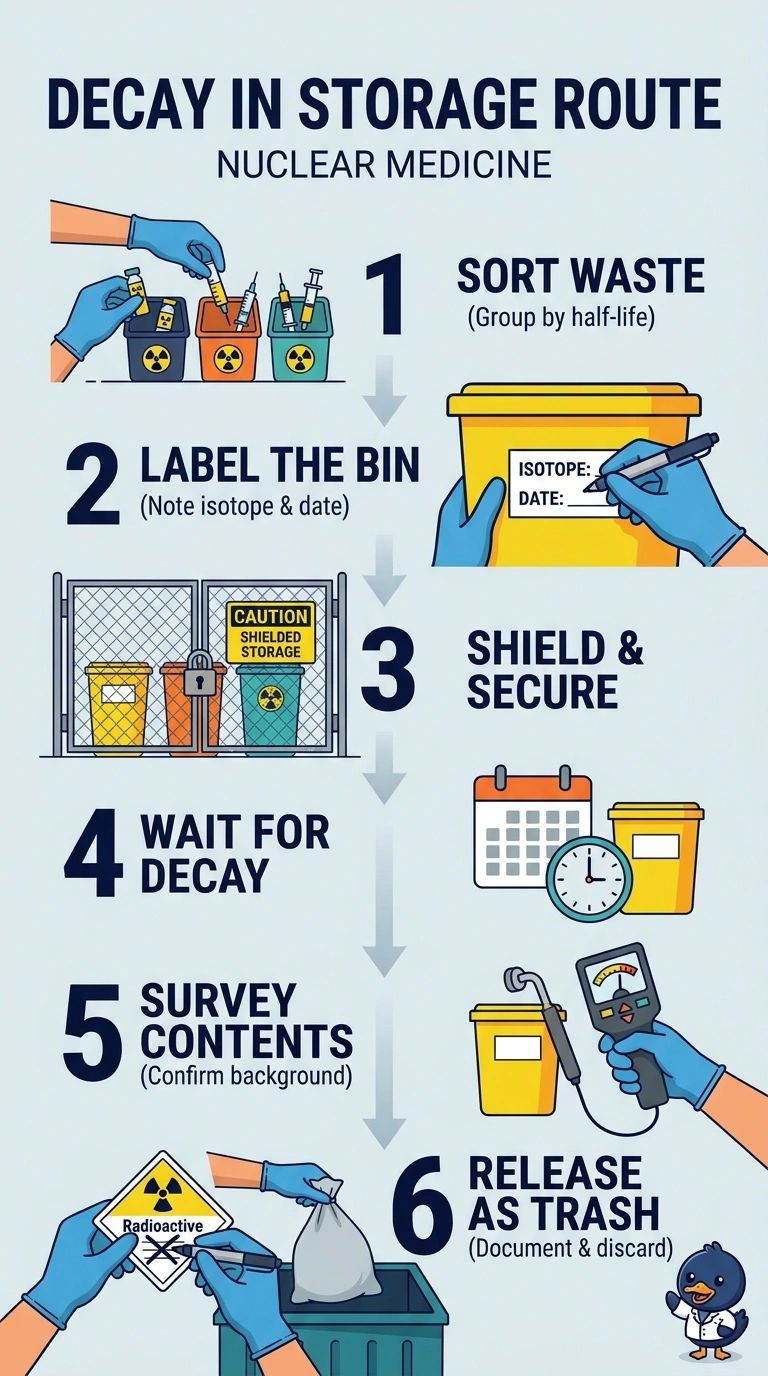
Short Explanation
You should hold the pads, gloves, and syringes for decay in storage, then survey them and document that their readings are indistinguishable from background before discarding them as ordinary trash. It’s like checking that a timer has truly run out before opening the door—waiting alone isn’t enough.
Full Explanation
The pads, gloves and syringes are contaminated with a short-lived imaging agent, so the appropriate route is decay-in-storage: retain them until their activity has decayed, survey them to confirm readings are indistinguishable from background, document that release check, and then discard them as ordinary trash. The separate long-lived sealed reference source remains in the lab and does not determine the route for these short-lived contaminated items. Sending the items to a licensed radioactive-waste contractor is a recognized waste-management route, but it fails the stated requirement to use the route matching this waste’s short half-life; decay storage and documented clearance are the specified route. Using a regulatory clearance limit instead of confirming readings are indistinguishable from background substitutes a different release criterion, even if that limit is permitted in some jurisdictions or circumstances. Completing the release record only after ordinary-trash disposal reverses the required sequence: documentation must establish clearance before release, not retrospectively. Exam caveat: “ten half-lives” is often used as a planning rule, but elapsed time alone does not establish that an item meets the required survey criterion. Practical check: verify the applicable procedure’s survey method and background comparison, and ensure the dated release record is complete before the waste leaves controlled handling.