
A young adult with recurrent painless rectal bleeding is scheduled for a Meckel diverticulum study, and the surgical team wants the earliest possible answer about ectopic gastric mucosa. A low-lying focus could sit among bladder and ureteral activity in the pelvis. Which acquisition plan captures uptake earliest while still clearing bladder activity from the pelvis?
Select an answer to reveal the explanation.
Short Explanation
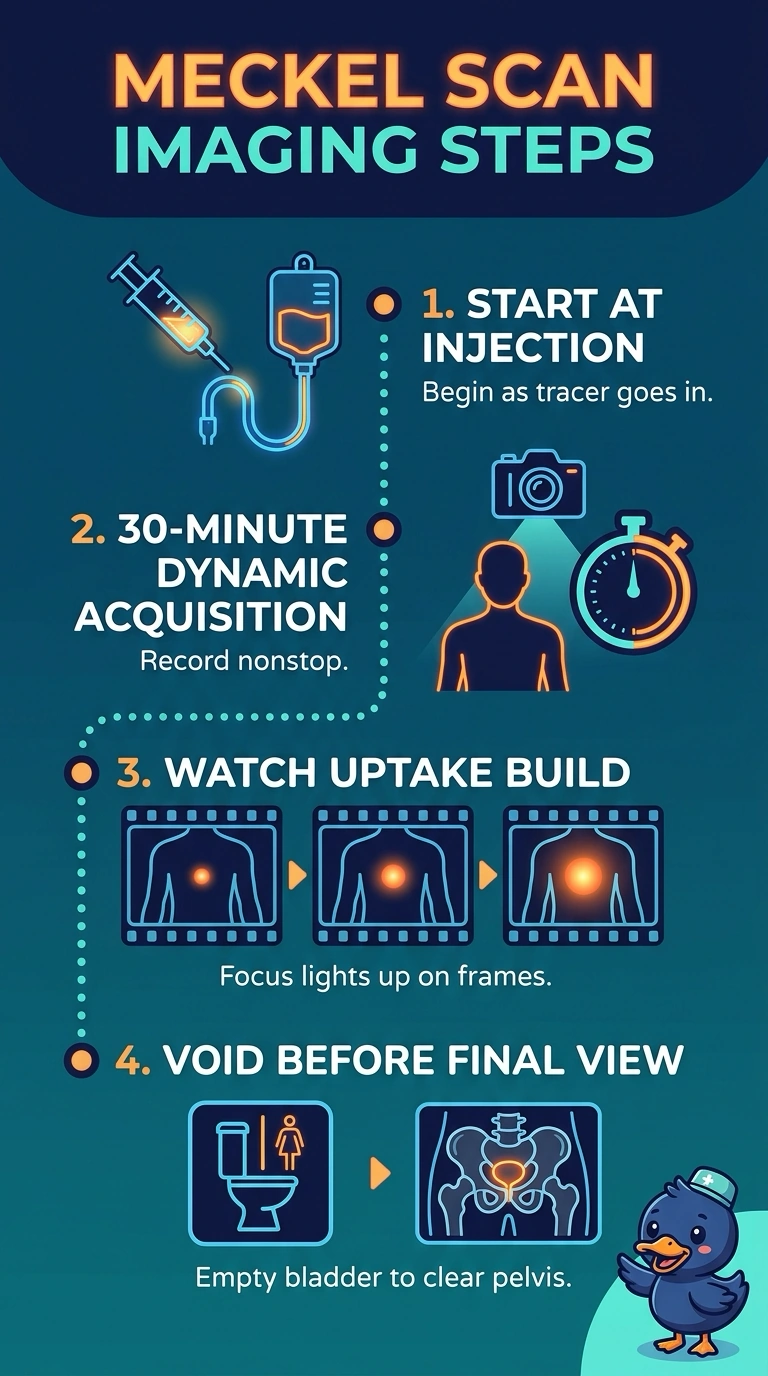
Begin dynamic imaging when the tracer is injected, so you can catch uptake as early as possible—like watching a door from the moment it opens. Then get pelvic views after you void to clear bladder activity that could hide a low-lying focus; this sequence gives you an early answer and a clearer view.
Full Explanation
Tc-99m pertechnetate is taken up by gastric mucosa, including ectopic gastric mucosa in a Meckel diverticulum. A 30-minute dynamic acquisition begun at injection records uptake as it happens and can capture an early focus, while post-void pelvic views reduce bladder activity that might obscure a low-lying focus. Planar images that begin 20 minutes after injection may miss the onset of uptake, even if repeated every 10 minutes and followed by a post-void view. A 60-minute dynamic acquisition beginning at injection captures early uptake, but without a post-void pelvic view, bladder activity may still obscure a pelvic focus. An H2 blocker may be used as an adjunct to reduce secretion of tracer into the bowel lumen, but static images every 10 minutes do not capture uptake as continuously or as early as dynamic imaging from injection. Exam caveat: an H2 blocker does not replace early acquisition or the post-void view when both are needed. Practical check: confirm the dynamic sequence starts at injection and that the patient voids before the pelvic views.