
Today's intrinsic flood is accepted as even and the Tc-99m photopeak sits correctly, yet two SPECT acquisitions show the same circular smearing of activity around the center of the reconstruction. Which quality control test should the technologist run first to trace this artifact?
Select an answer to reveal the explanation.
Short Explanation
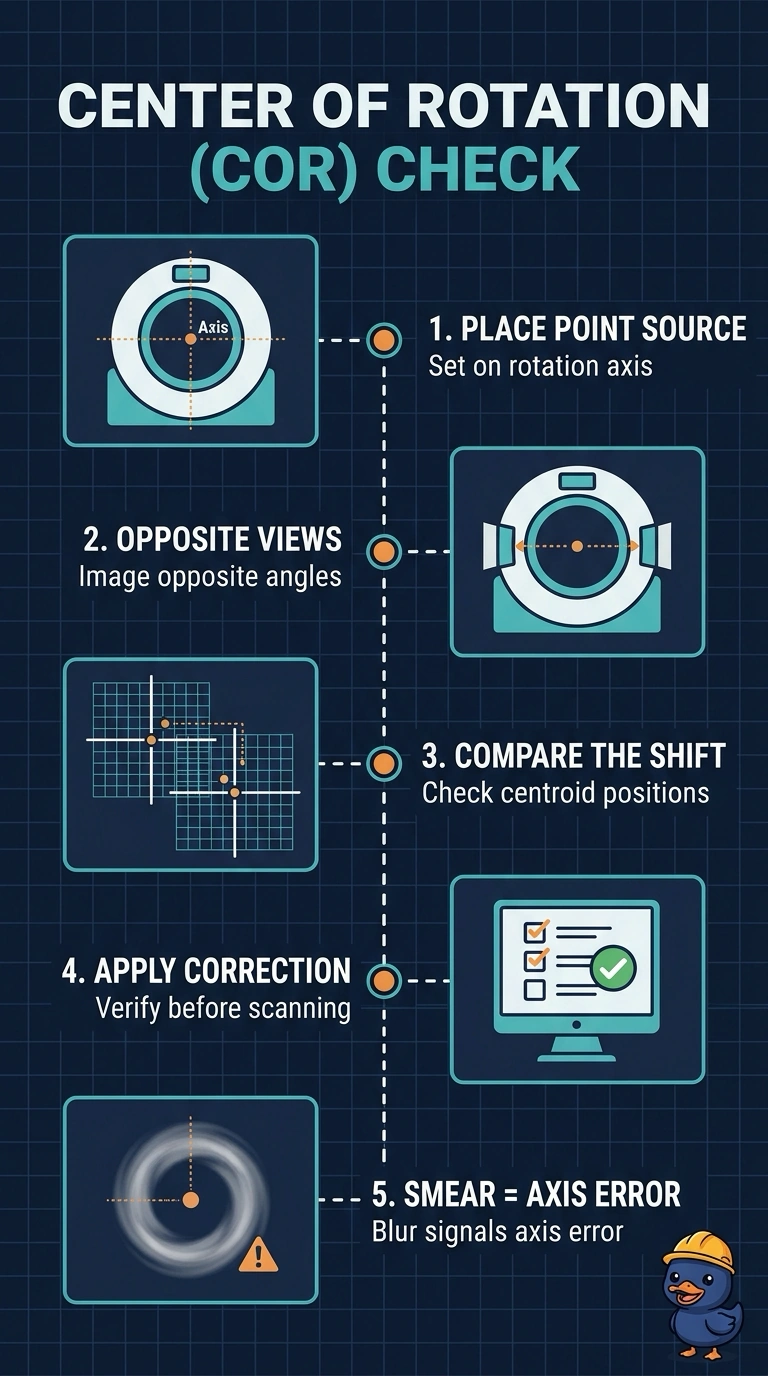
You’ll want to start with a center of rotation measurement using a centered point source, comparing its centroid positions at opposing gantry angles. It’s like checking whether a spinning wheel stays centered as it turns; uniformity, resolution, and sensitivity tests don’t directly check that alignment.
Full Explanation
A circular smear around the center of a reconstructed slice can result from a center-of-rotation error, because projection data are reconstructed about an axis that does not match the actual gantry rotation axis. A centered point source imaged through multiple gantry angles lets the technologist assess centroid displacement, including between opposing projections, and quantify the offset. An extrinsic flood evaluates count uniformity across the detector and does not directly measure rotational alignment. A bar phantom evaluates spatial resolution and linearity, not the rotation center. A sensitivity measurement evaluates counts per unit activity and does not directly assess rotational alignment. Uniformity problems can also degrade SPECT studies, so routine flood review should continue. After correction, verify the result before proceeding with the study.