
A cardiologist requests noninvasive confirmation of cardiac transthyretin amyloidosis in an older adult with heart failure and preserved ejection fraction. The report must grade myocardial uptake against rib uptake while separating activity from overlying bone and blood pool, and the visit must use the right patient preparation. Which amyloid imaging plan best satisfies these requirements?
Select an answer to reveal the explanation.
Short Explanation
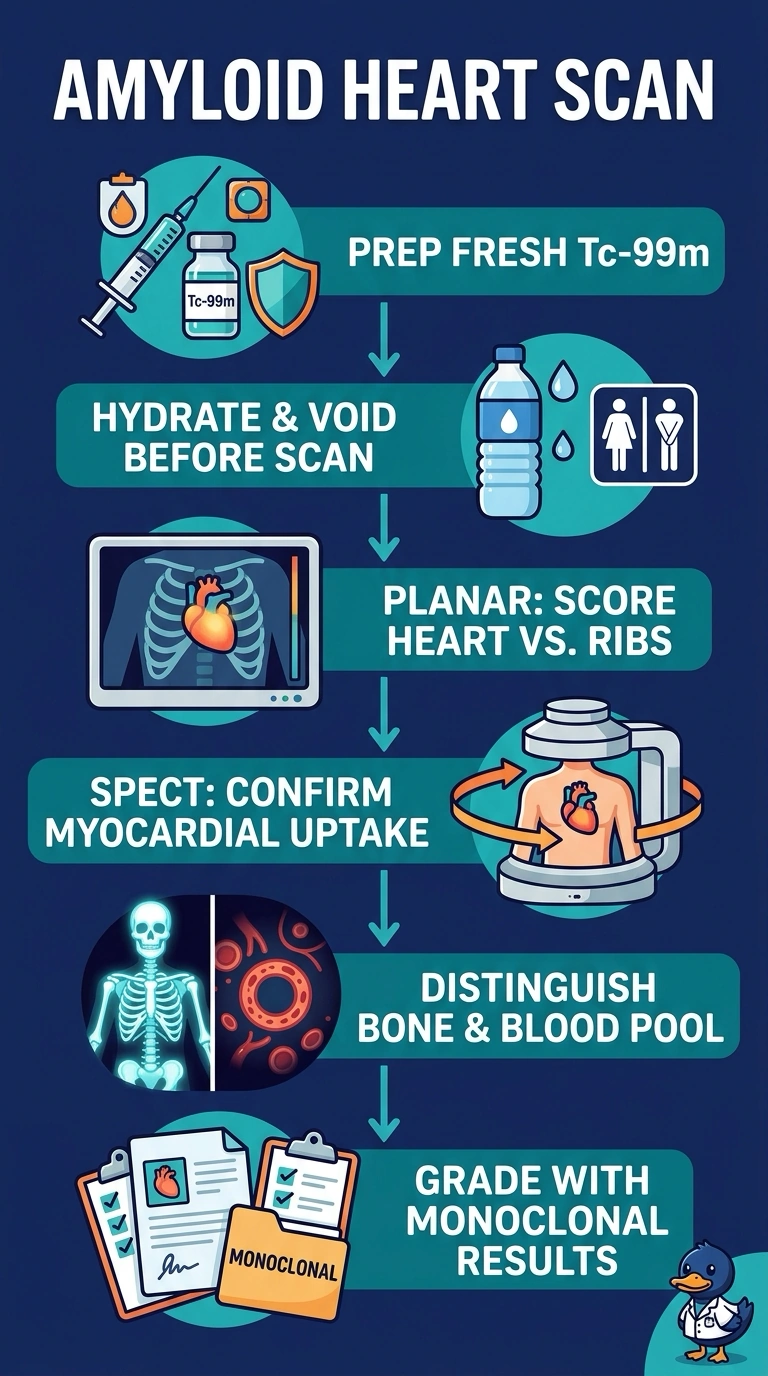
Planar images give you the rib-referenced grade, while cardiac SPECT acts like a map that separates heart uptake from nearby bone and blood pool; hydrate and have your patient void before imaging. A positive result supports ATTR only after you’ve excluded a monoclonal protein.
Full Explanation
The correct plan combines planar Tc-99m pyrophosphate imaging, which allows myocardial uptake to be graded against rib uptake, with cardiac SPECT to localize activity and distinguish myocardial signal from overlying bone or blood-pool activity. Hydration and voiding before imaging help clear urinary tracer and reduce pelvic or adjacent soft-tissue activity that can interfere with interpretation. The planar-only approach retains rib grading and appropriate preparation but lacks SPECT, so it cannot reliably separate true myocardial uptake from overlapping bone or blood pool. The approach without hydration or voiding includes both required image components and rib grading, but omits the specified patient preparation, which can leave residual blood-pool activity and degrade interpretation. SPECT with preparation can localize uptake and assess blood pool, but without planar rib comparison it does not provide the requested grading of myocardial uptake against rib uptake. Exam caveat: a positive bone-tracer scan supports ATTR cardiac amyloidosis only when a monoclonal protein disorder has been appropriately excluded; imaging alone does not distinguish ATTR from all causes of cardiac amyloid. Practical check: confirm the protocol includes both planar views and cardiac SPECT, and document that the patient hydrated and voided before acquisition.