
During a briefing, a technologist explains that Tc-99m imaging uses a 140 keV photon, that the camera records a photopeak plus a scatter tail, and that most interactions occur in soft tissue with a low atomic number. Which interaction accounts for most of those soft-tissue events at 140 keV?
Select an answer to reveal the explanation.
Short Explanation
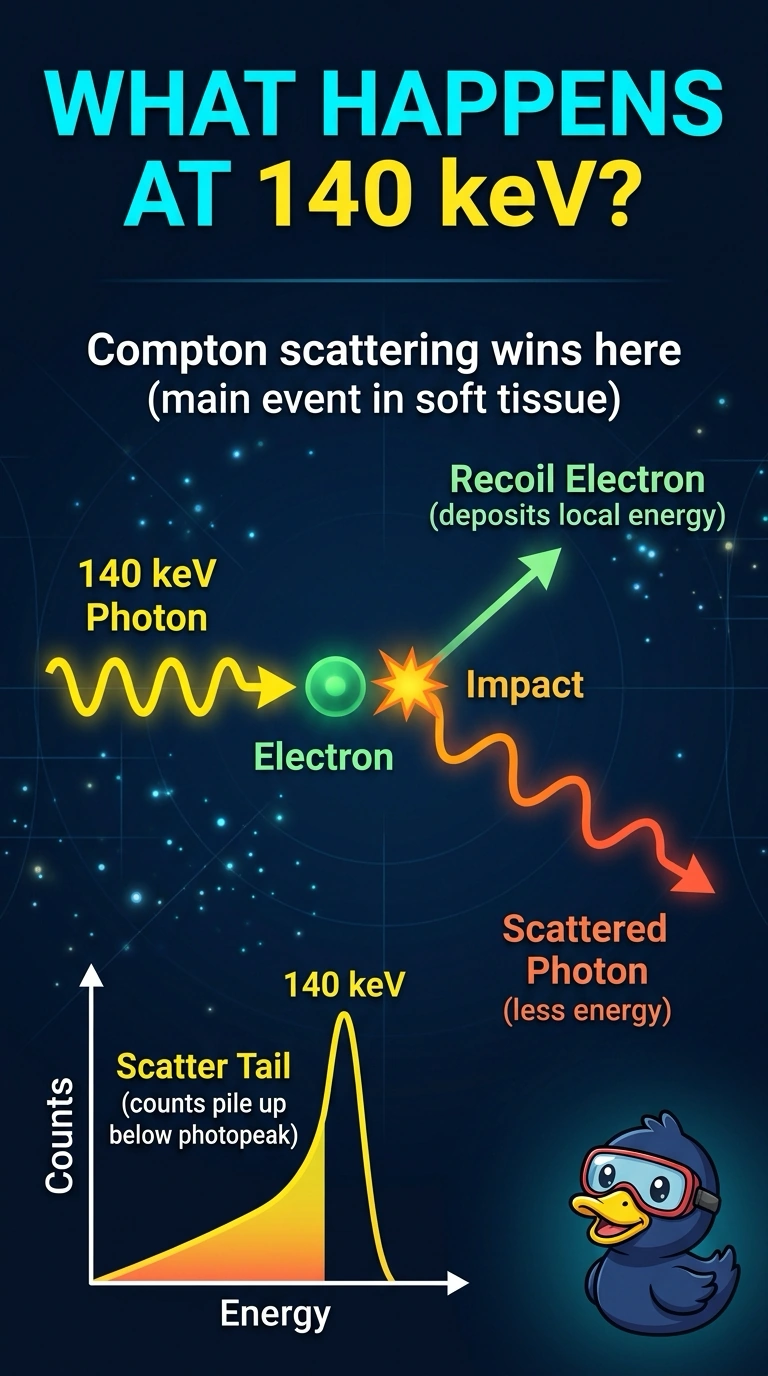
Compton scattering is the everyday hit at 140 keV: the photon clips a loose outer electron and bounces away with less energy, leaving you a recoil electron plus a scattered photon. It's that recoil electron that does the dose-dealing, while the escaped photon builds the scatter tail. Photoelectric favors a heavier atom and lower energy, coherent frees no electron at all, and pair production waits for far higher energy.
Full Explanation
Compton scattering dominates at 140 keV in soft tissue because the photon energy sits well above the binding energy of the outer electrons it meets, so the event behaves like a collision with a nearly free electron: part of the energy goes into a recoil electron and the rest leaves in a scattered photon of lower energy. That mechanism produces the down-scatter counts below the photopeak and carries much of the dose in the patient. Photoelectric absorption fails as the dominant event because its probability falls steeply as photon energy rises and as atomic number drops, so a 140 keV photon in low-Z soft tissue is far likelier to scatter than to be absorbed whole after ejecting a bound electron. Coherent scattering fails because it deposits no energy and frees no electron, and it accounts for only a small share of interactions at this energy in low-Z material. Pair production fails on threshold alone, since it requires a photon above 1.022 MeV to create an electron-positron pair, with annihilation then releasing two 511 keV photons. Exam caveat: photoelectric absorption regains dominance in high-Z material such as bone at lower energies, so read energy and material together. Practical check: sort each interaction by energy window and by the material where it rules.