
An alert adult on the oncology unit is offered enrollment in a trial of an investigational radiopharmaceutical. The patient has an advance directive on file, holds a DNR order signed today, and asks whether declining will change the imaging already ordered. Which point should anchor the informed consent discussion?
Select an answer to reveal the explanation.
Short Explanation
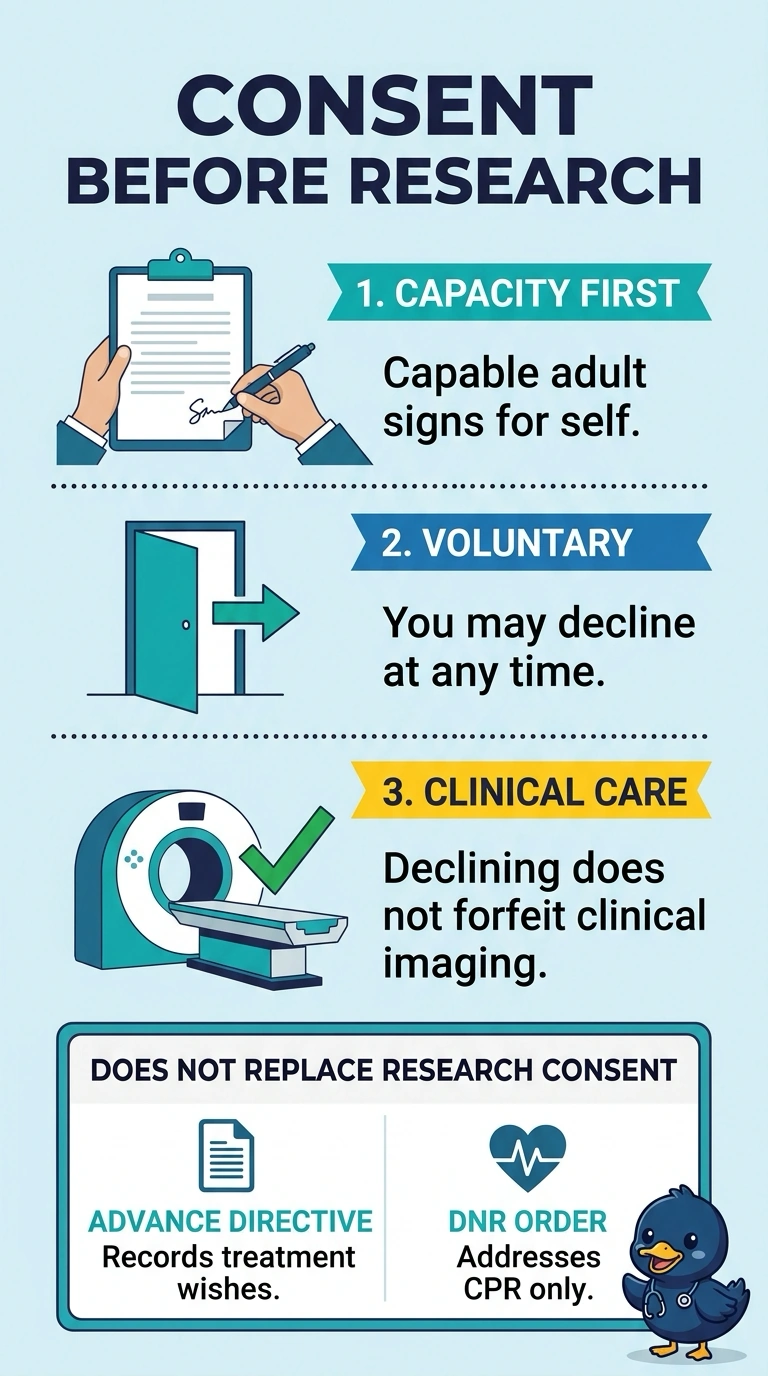
You're the one who gives research consent while you can decide for yourself, and that choice stays voluntary. A DNR is about resuscitation, not permission for a trial. The trap is skipping the consent conversation because a document is already on file.
Full Explanation
Voluntary informed consent protects the participant: you receive the study purpose, procedures, risks, alternatives and the right to withdraw, and your decision must be free of pressure. Declining does not forfeit otherwise available clinical care. Assess decision-making capacity; a patient with capacity gives their own consent before any study-specific procedure begins. An advance directive records treatment wishes but does not replace a study-specific discussion or itself authorize research. Requiring a surrogate signature fails because surrogate permission applies when a participant lacks decision-making capacity, subject to applicable requirements. Using the DNR order as the basis for the decision fails because a DNR order addresses cardiopulmonary resuscitation; it neither authorizes research nor cancels imaging. Exam caveat: these documents can appear together to test whether you keep consent, resuscitation and advance care planning separate. Practical check: confirm capacity, then walk the consent form section by section and say plainly that standard care remains available either way.