
A 78-year-old with limited English and marked hearing loss, who reads lips only in her first language, arrives for a hepatobiliary scan with her daughter, who answers every question before the patient can reply. You need the history straight from the patient and must confirm that she understands the procedure. Which communication approach handles her language and hearing barriers while giving you an accurate history?
Select an answer to reveal the explanation.
Short Explanation
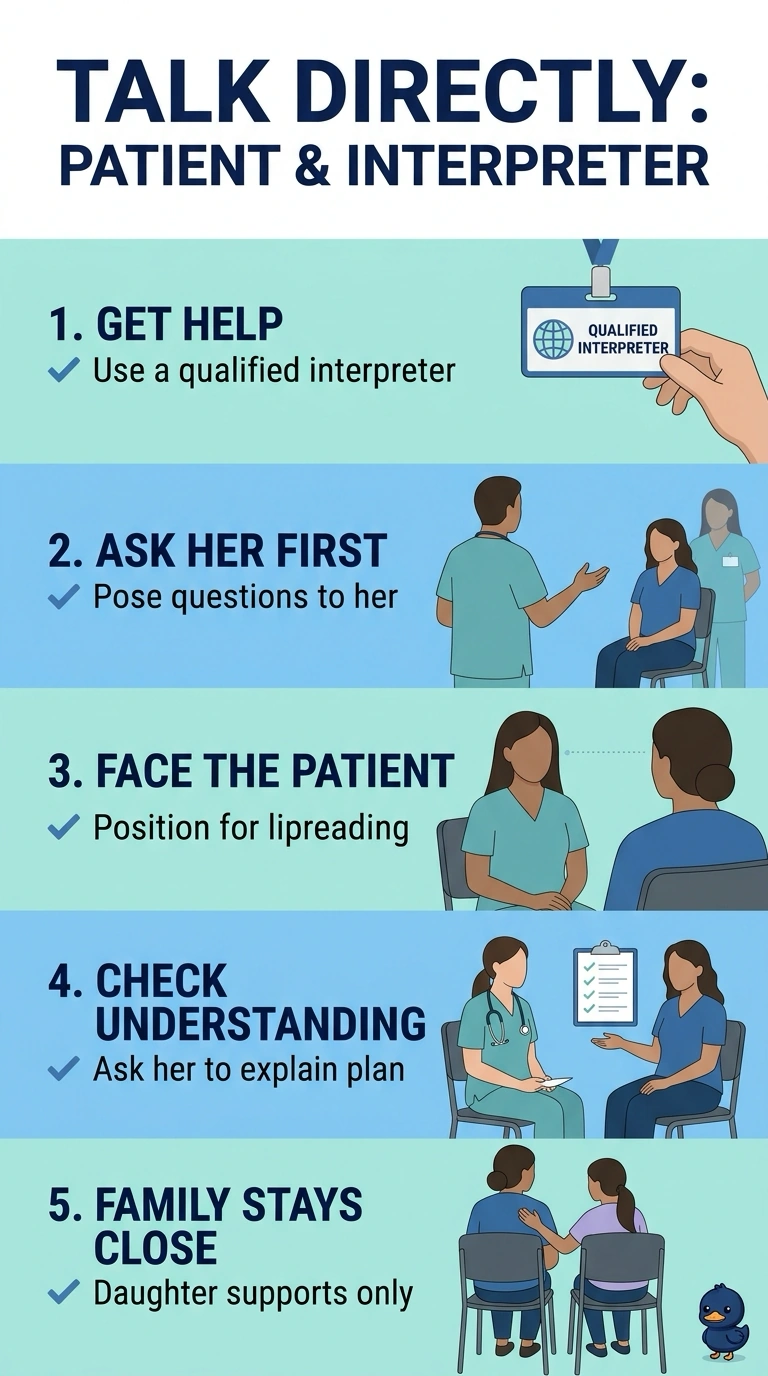
Use a qualified interpreter in your patient’s first language, positioned so she can lip-read, and direct your questions to her—not her daughter. It’s like tuning a message to the right channel: this supports both communication needs and helps you get her own accurate history.
Full Explanation
The correct approach addresses all three needs: a qualified interpreter can accurately convey the patient’s first language, positioning the interpreter where the patient can see their face supports her reliance on lipreading, and directing questions to the patient preserves her role as the source of her own history. A qualified interpreter over the telephone is a familiar way to obtain language support and keeps questions directed to the patient, but it provides no visible speaker for lipreading, so it does not accommodate the stated hearing and communication needs. A bilingual staff member can be positioned for lipreading and speak directly with the patient, but being bilingual alone does not establish qualification to interpret; using an unqualified intermediary risks omissions or altered meaning when confirming history and understanding. Asking the daughter to verify dates and medications after interviewing the patient may seem like a useful corroboration step, but it makes the history partly dependent on the daughter, contrary to the requirement to obtain it straight from the patient. Exam caveat: family members may offer context when appropriate, but should not replace a qualified interpreter for communication that requires accurate interpretation. Practical check: before proceeding, confirm directly with the patient—using the interpreter—that she can see and understand the communication and can explain the procedure in her own words.