
A hospital opens a satellite nuclear medicine room that must handle three jobs: quantify exposure rate at the prep counter, screen the bench for surface contamination, and assay a syringe of radiopharmaceutical before injection. An ionization chamber survey meter, a GM survey meter with an end-window probe, a dose calibrator, and a well counter are available. Which assignment of instrument to job is correct?
Select an answer to reveal the explanation.
Short Explanation
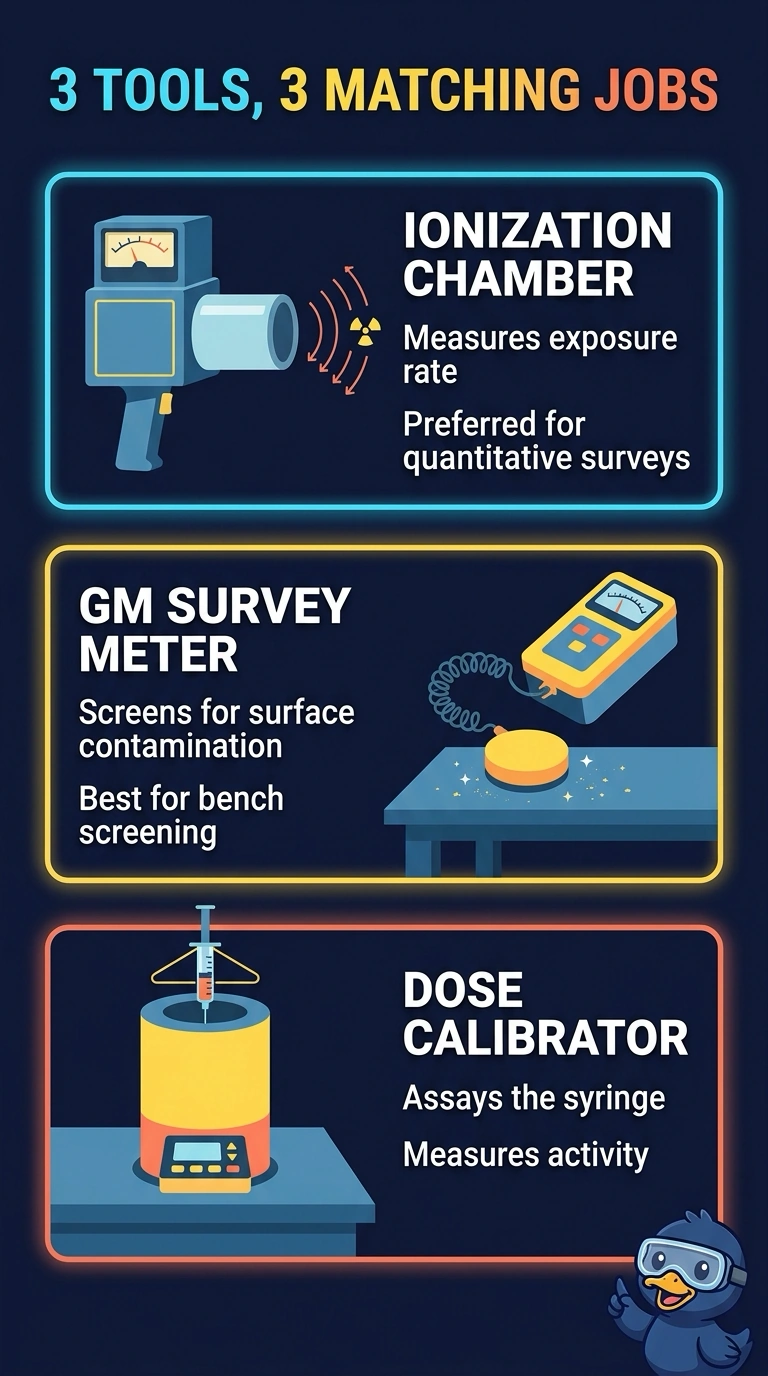
You can match each instrument to its job like choosing the right tool for a repair: the ionization chamber measures exposure rate, the GM survey meter checks for surface contamination, and the dose calibrator assays the syringe. The dose calibrator tells you how much activity is in the radiopharmaceutical before injection.
Full Explanation
An ionization chamber survey meter is generally preferred for quantitative exposure-rate measurements because its response is more suitable for this purpose than that of a standard GM survey meter. A GM end-window probe is useful for locating surface contamination, though it does not by itself determine whether contamination is removable; that requires a wipe test and counting the wipe with an appropriate counter. A dose calibrator is a reentrant ionization chamber designed to measure radionuclide activity in containers such as syringes. A well counter measures counts from samples in its well and is not the appropriate instrument for directly assaying a syringe in its intended geometry. Energy-compensated GM survey meters may provide exposure-rate readings in some applications, but the ionization chamber is the best choice here for quantitative measurement.