
During morning dose preparation, a bone imaging referral arrives for an adult with a known prostate primary being staged for osseous spread. The tracer must settle onto calcium phosphate mineral where new bone is being formed, and it must come from a generator-eluted kit. Which radiopharmaceutical's localization mechanism matches this study?
Select an answer to reveal the explanation.
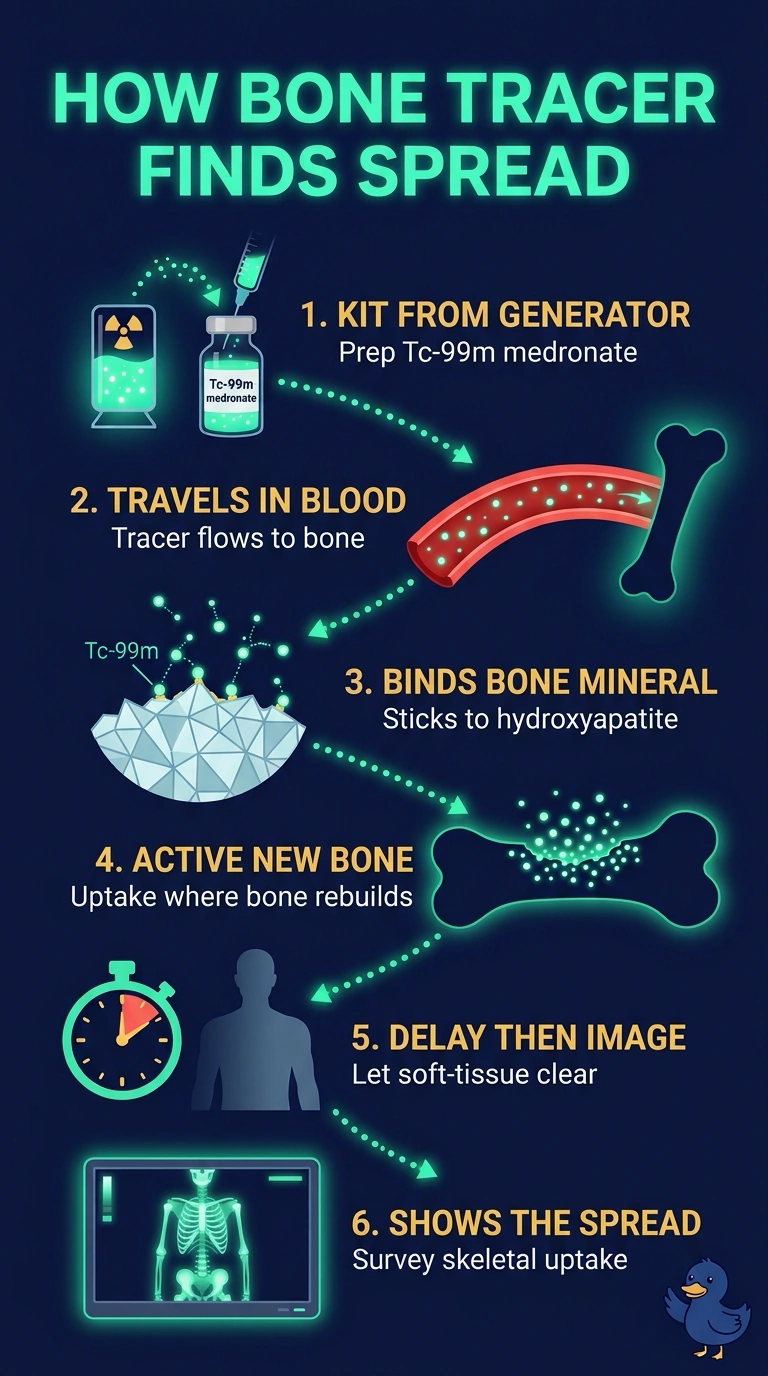
Short Explanation
Medronate binds the mineral your patient is laying down during osteoblastic turnover, which is what a staging bone survey targets. It behaves like fresh plaster catching paint wherever the bone crew is patching, and it is prepared using generator eluate. The other agents follow different biology and answer different clinical questions.
Full Explanation
Technetium-99m medronate is a diphosphonate that travels to bone with blood flow and then binds by surface adsorption onto the calcium phosphate of hydroxyapatite. Uptake rises wherever osteoblasts are actively mineralizing new matrix, which is the physiology a staging bone survey is designed to reveal. The radiopharmaceutical is prepared from a kit using generator-eluted pertechnetate. The reticuloendothelial colloid approach fails because sulfur colloid particles are phagocytosed by cells in the liver, spleen and bone marrow rather than deposited in mineral, so it maps reticuloendothelial distribution instead of bone turnover. The pulmonary trapping approach fails because macroaggregated albumin lodges in pulmonary capillaries by particle size, producing a lung perfusion study with no skeletal information. The lipophilic cation approach fails because sestamibi crosses cell membranes and is retained in cells with high mitochondrial activity, reflecting perfusion and metabolism rather than new bone formation. A purely lytic lesion with little osteoblastic reaction can appear photopenic even with the correct tracer. Imaging is typically delayed to allow soft-tissue clearance, and the patient should void before imaging to reduce bladder activity that could obscure the pelvis.