
A patient who received outpatient radionuclide therapy is ready to go home, and the family plans to drive with a toddler in the back seat. The patient feels well and asks whether a blood test can settle whether leaving today is safe. Under NRC requirements, which factor determines when this patient may be released?
Select an answer to reveal the explanation.
Short Explanation
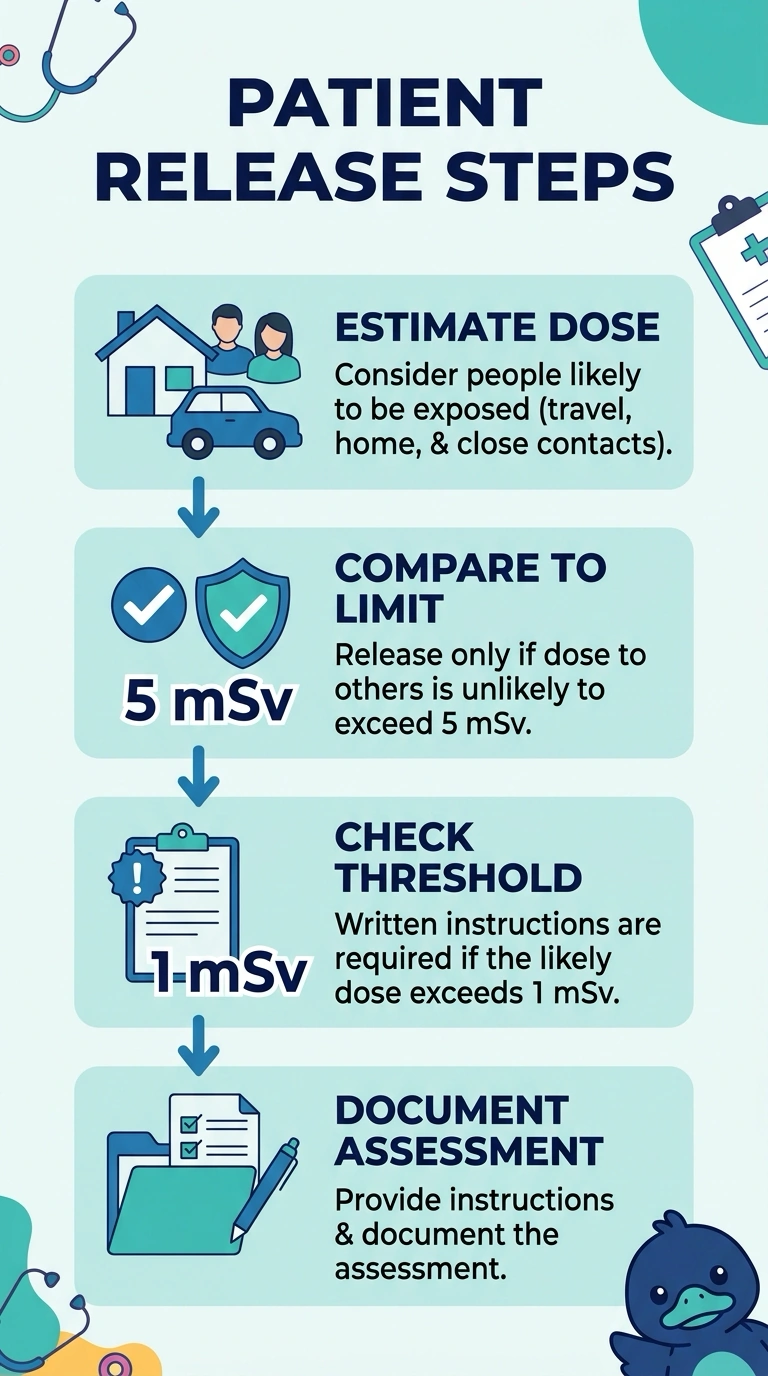
You can feel well and still need to consider how much radiation someone else may receive, including the toddler during the drive. Under NRC rules, release depends on whether another individual’s likely total effective dose equivalent is no more than 5 mSv, and written instructions are required if the likely dose exceeds 1 mSv.
Full Explanation
Under NRC requirements, release depends on whether the total effective dose equivalent (TEDE) to any other individual is unlikely to exceed 5 mSv. If the likely dose to an individual exceeds 1 mSv, the patient must receive written instructions on actions to keep that dose within the limit. Feeling well or obtaining a blood test does not by itself determine release; the assessment concerns exposure to others, including the toddler during the car ride. Limiting the 5 mSv assessment to an adult caregiver is insufficient because another individual, such as the toddler, may receive the relevant dose. Using a 5 mSv threshold for written instructions confuses that trigger with the separate 1 mSv threshold. Assessing external dose alone may omit dose from intake of radioactive material when that pathway is relevant, so it does not establish the required TEDE. Exam caveat: keep the 5 mSv release criterion distinct from the 1 mSv written-instruction trigger. Practical check: document patient-specific dose estimates for likely contacts and travel conditions, including the toddler’s proximity and time in the vehicle, and provide written instructions when the 1 mSv threshold is exceeded.