
A hospital is choosing an aerosol delivery system for Tc-99m DTPA ventilation imaging in an exam room that opens onto a busy corridor. The study needs uniform lower-airway deposition from several minutes of quiet mouthpiece breathing, and spent aerosol must be captured before it reaches room air. Which nebulizer specification should the department require?
Select an answer to reveal the explanation.
Short Explanation
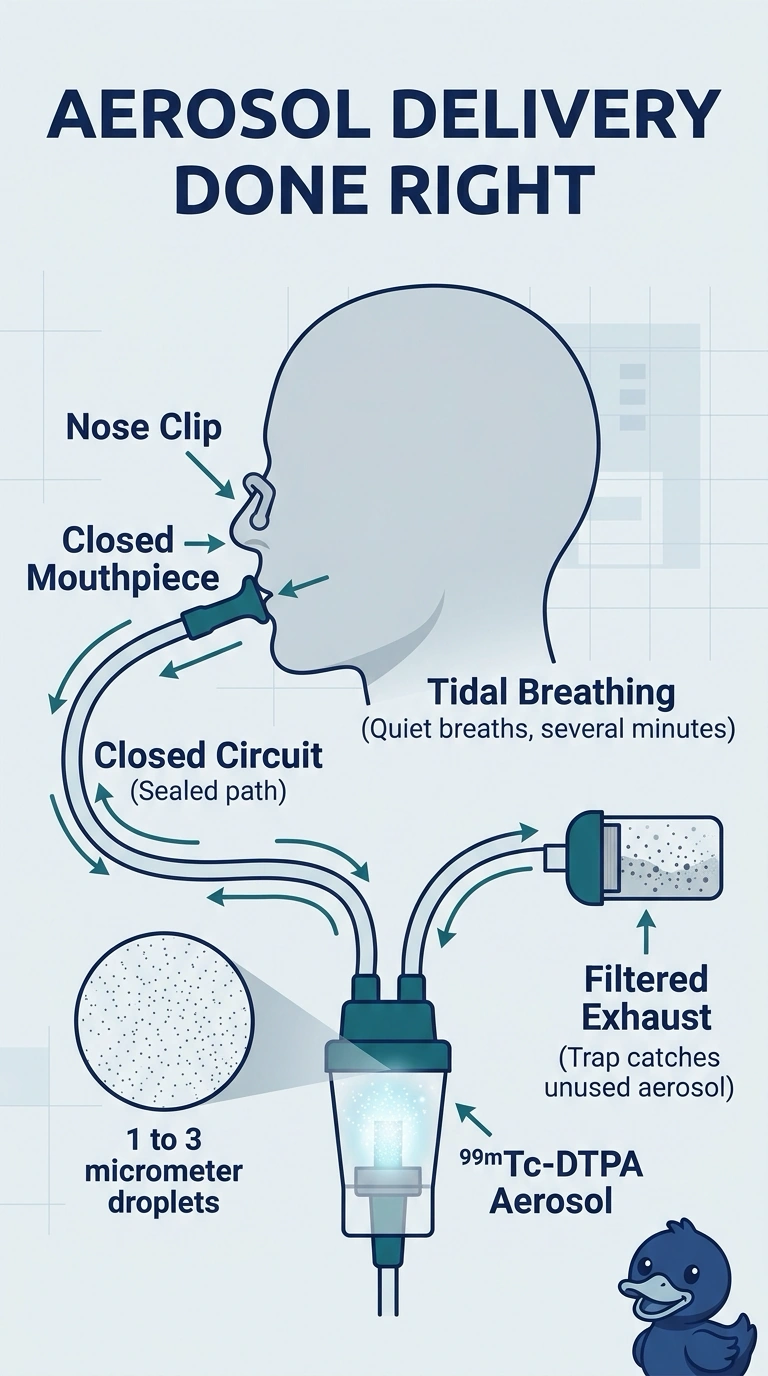
You need a closed mouthpiece nebulizer that sends spent aerosol through a filter, while producing 1–3 micrometer particles during several minutes of quiet breathing. It’s like catching the mist before it escapes into the corridor, while letting fine droplets reach the lower airways.
Full Explanation
A filter-vented closed nebulizer directs exhaled aerosol through a filter, helping reduce its release into the room. The generator produces aerosol, the mouthpiece delivers it during quiet tidal breathing, and the exhaust filter captures much of what the patient does not inhale. This combination supports staff-exposure control and lower-airway deposition for ventilation imaging. The open-circuit approach does not meet the containment requirement because aerosol may escape around the mouthpiece. Larger particles tend to deposit more in the mouth and larger airways than smaller particles, reducing lower-airway delivery and potentially increasing swallowed activity. The face-mask approach does not meet the specified mouthpiece interface; mask delivery is used in some settings, but it does not match this scenario's requirement. Particle size is commonly described using mass median aerodynamic diameter, so treat the stated range as a specification rather than one exact value. Practical checks include measuring residual activity in the nebulizer after the run and surveying the room before the next patient.