
A quality check on a freshly prepared Tc-99m kit shows more free pertechnetate than the package insert allows. The eluate was drawn within its labeled time and used within its stated stability period, the kit vial was stored as labeled and is in date, and the first dose was drawn only after the full incubation period. Which preparation condition most likely accounts for the excess free pertechnetate?
Select an answer to reveal the explanation.
Short Explanation
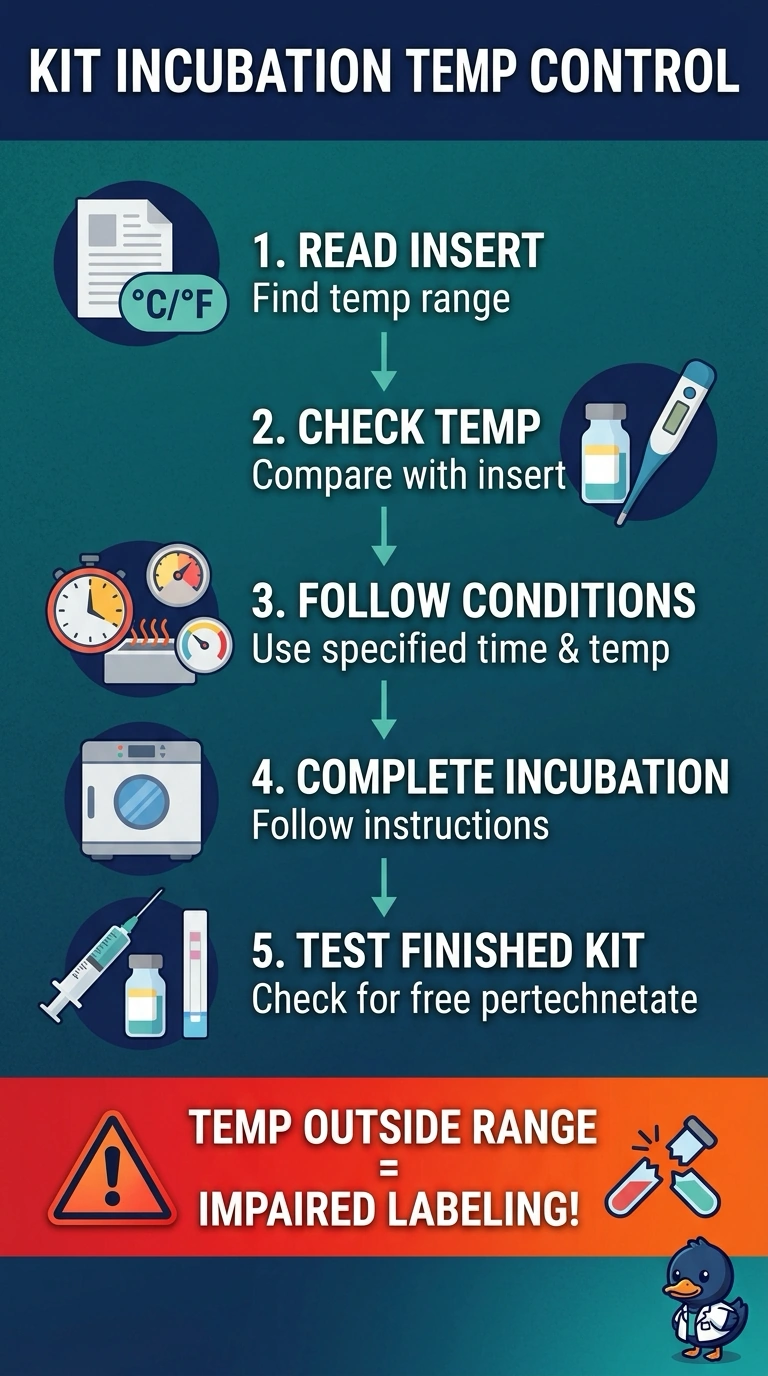
You’ve ruled out the eluate, storage, and timing, so check the incubation temperature. It’s a bit like glue that needs the right conditions to set: if the temperature falls outside the package-insert range, labeling can be impaired and leave excess free pertechnetate.
Full Explanation
The correct explanation is that incubation temperature must remain within the product-specific range in the package insert. Kit labeling depends on reduction of pertechnetate by stannous ion and its subsequent binding to the intended compound; temperature outside the validated range can impair these reactions even when the incubation lasts long enough. Lead shielding is appropriate radiation protection, but shielding does not preserve labeling yield by preventing meaningful radiolytic damage under routine kit-preparation conditions; it also does not control the reaction temperature. Measuring eluate activity is a useful dose-preparation and documentation step, but activity measurement alone neither establishes that the eluate is chemically suitable nor promotes reduction or binding. Gentle mixing can help distribute reagents, but it cannot compensate for reaction conditions outside the validated temperature range, and mixing at the start does not establish that temperature remained acceptable during incubation. A useful exam caveat is that the permitted temperature and incubation instructions are kit-specific, so general rules should not replace the package insert. In practice, check the actual vial or bath temperature over the full incubation interval, rather than relying only on the room setting or a single reading; also verify that the thermometer is calibrated and that the vial was exposed to the measured conditions.