
A technologist who receives and assays I-131 patient doses in a dispensing area needs whole-body monitoring, hand monitoring, and an audible warning while the task is under way. For this task, the collar is the location where the highest deep dose is expected. Which personnel monitoring arrangement meets all four requirements?
Select an answer to reveal the explanation.
Short Explanation
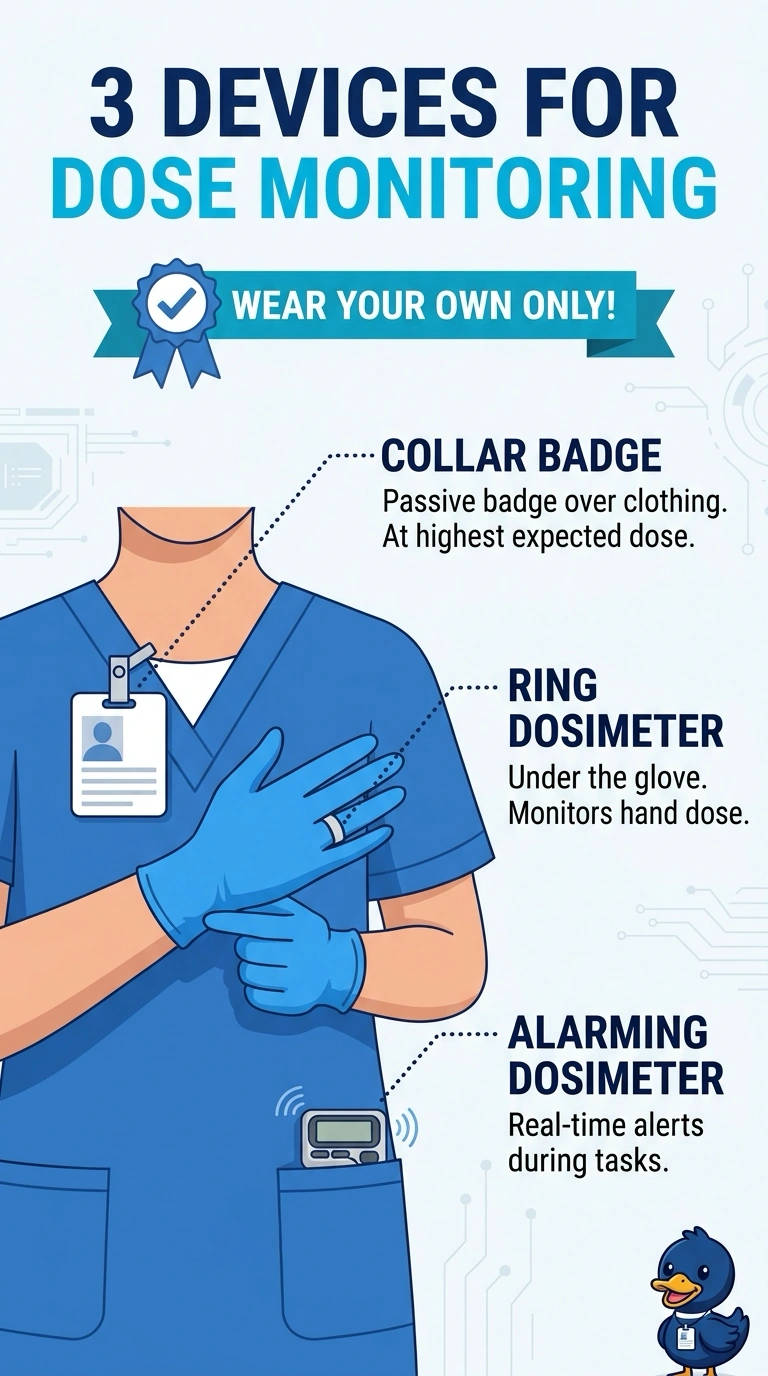
You’ll place the passive whole-body dosimeter at the collar, where this task’s highest deep dose is expected, and wear a ring dosimeter under your glove to monitor hand dose. A real-time alarming dosimeter provides a warning while you work, including the required audible alarm.
Full Explanation
The correct arrangement meets all four requirements: the passive whole-body dosimeter is worn at the collar, where this task’s highest deep dose is expected; the ring dosimeter monitors hand exposure; and the real-time alarming dosimeter provides an audible warning while the task is under way. A setup with a visual display and vibration but no audible alarm provides collar and hand monitoring, yet fails the stated audible-warning requirement. A setup with the passive whole-body dosimeter at the waist includes a ring and an audible real-time alarm, but the waist location does not follow the stated fact that the collar is where the highest deep dose is expected. A setup with a collar dosimeter and an audible alarm uses a wrist dosimeter outside the glove rather than a ring; a wrist dosimeter is not a substitute for hand monitoring and may not adequately represent dose to the fingers during dose handling. An exam caveat is that a passive dosimeter records accumulated exposure for later assessment, whereas a real-time alarming dosimeter provides an immediate warning; one does not automatically replace the other. In practice, confirm that the dosimeter type and alarm settings are appropriate for the radionuclide and task, and verify that the ring is worn as directed by the radiation safety program.