
While surveying the hot lab, a technologist records 6 mR/h on an ion chamber meter near a shielded syringe, and the personal dosimeter worn during that shift reads 15 mrem. The supervisor asks students to name each quantity before any occupational limit is considered. Which statement correctly pairs each reading with the dose quantity it represents?
Select an answer to reveal the explanation.
Short Explanation
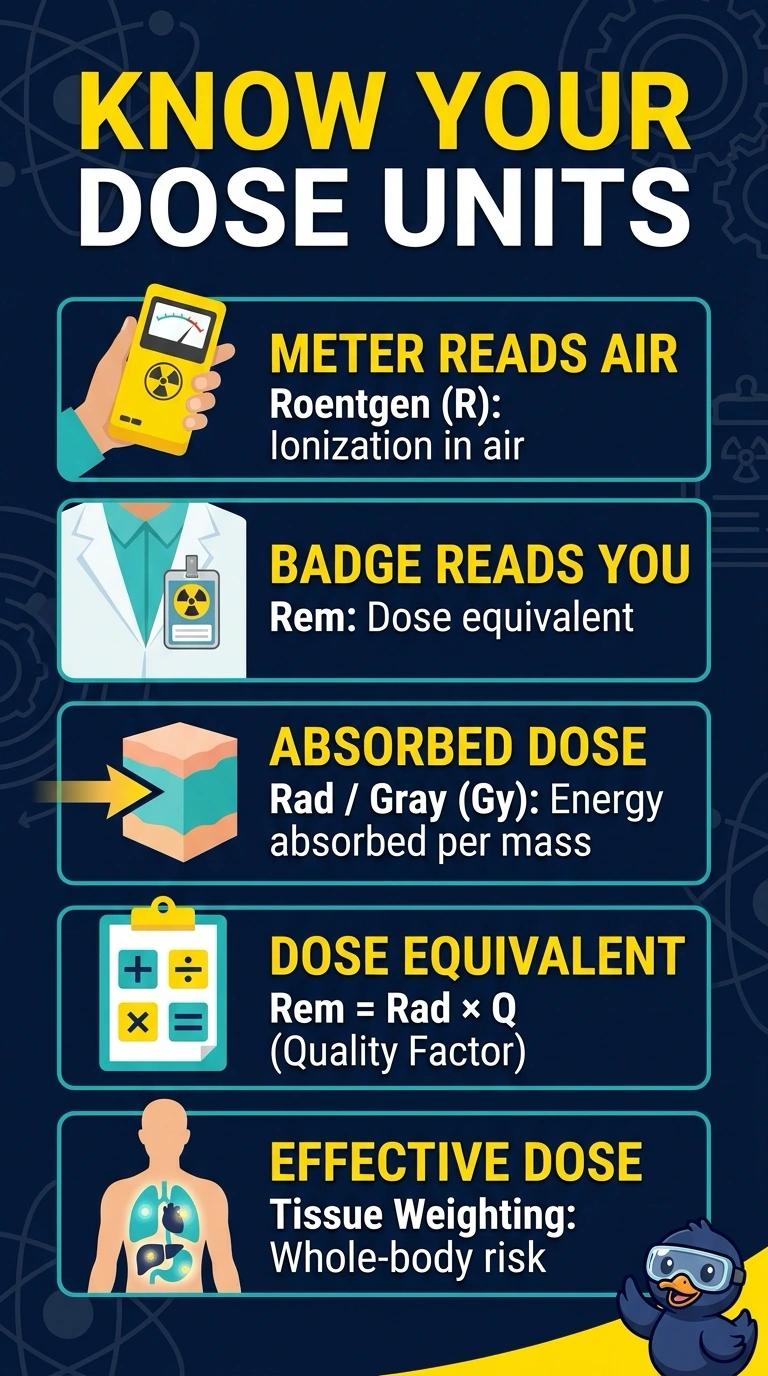
Exposure describes ionization produced in air, while dose equivalent accounts for the biological effectiveness of radiation. The ion chamber reading is exposure, and the dosimeter reading is dose equivalent, so they represent different quantities. Two gauges on one dashboard: one reads the room, the other reads your personal dose.
Full Explanation
Exposure describes the electric charge of ions produced in air per unit mass and is reported in roentgen. An ion chamber survey meter calibrated to display mR/h reports exposure rate at the point of measurement. Absorbed dose describes energy deposited per unit mass and is reported in gray or rad. Dose equivalent accounts for the biological effectiveness of radiation and is reported in sievert or rem. A personal dosimeter may report personal dose equivalent, such as deep dose equivalent, in millirem; the exact quantity depends on the dosimeter and its calibration. Occupational limits apply to specified quantities, including total effective dose equivalent and organ-specific dose equivalents. Pairing absorbed dose with effective dose confuses an air exposure reading with energy deposited in tissue and a personal dosimeter reading with a tissue-weighted quantity. The units shown and the dosimeter’s calibration determine what the readings represent. Exam caveat: some electronic dosimeters display dose equivalent in mrem, so read the unit rather than relying on the device name. Confirm the units on the display and calibration information before comparing a reading with a limit.