
A colleague has just drawn a Tc-99m sestamibi dose for an outpatient myocardial perfusion study, and the syringe sits unshielded on the counter while the activity is recorded. Verify the patient, radiopharmaceutical, and prescribed activity against the written order; also confirm the labeled activity’s calibration time and the drawn volume. Hand exposure must stay low. Which plan meets both requirements?
Select an answer to reveal the explanation.
Short Explanation
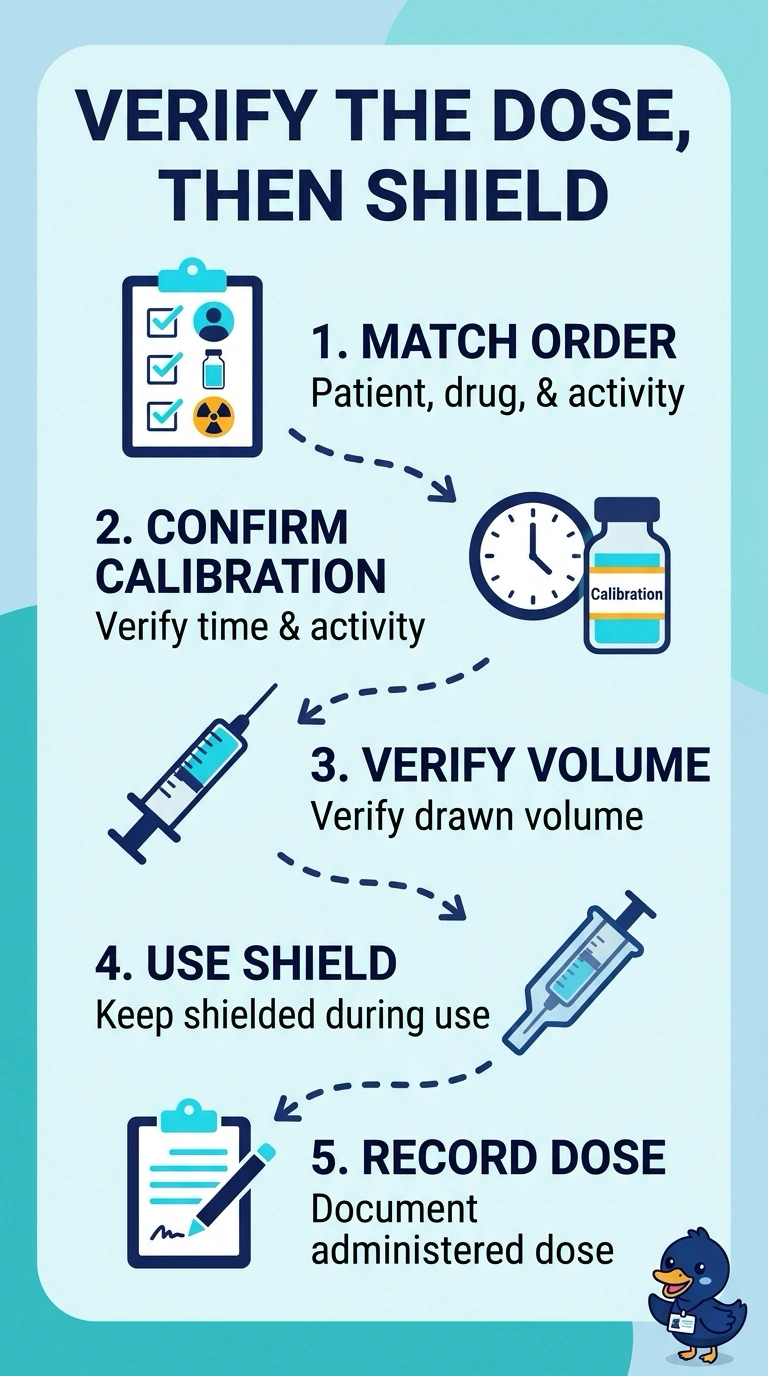
Treat the order like your preflight checklist: match the patient, radiopharmaceutical, and prescribed activity, then confirm the label’s calibration time and drawn volume. Use a syringe shield to keep your hand exposure low during injection, and record the administered dose.
Full Explanation
The correct plan uses a complete pre-injection verification and radiation-protection approach: match the patient, radiopharmaceutical, and prescribed activity to the written order; confirm both the labeled calibration time and the drawn volume; then inject through a syringe shield and record the administered dose. The calibration time matters because technetium-99m activity decreases through radioactive decay, so the labeled activity is meaningful only with its reference time. Checking volume also helps verify the prepared dose rather than relying on activity information alone. A syringe shield reduces hand and extremity exposure from gamma radiation during handling and injection. The incomplete-dose-verification approach that omits volume is inadequate because it leaves a preparation check undone; the approach that omits calibration time is inadequate because it ignores decay when interpreting labeled activity. The glove-only approach relies on contamination protection, not radiation shielding: gloves do not meaningfully attenuate gamma rays. Exam caveat: labels and required fields can vary, so follow applicable facility procedures for additional label checks and documentation. Practical check: before injection, compare the order with the syringe label, verify its calibration time and volume, and ensure the syringe shield is in place; afterward, record the administered dose.