
A patient with a liver tumor is being evaluated for Y-90 microsphere therapy, and the team needs a pretherapy Tc-99m MAA lung shunt estimate before deciding the dose. The MAA has to follow the same route the microspheres will take, and depth-related counting error has to be cancelled. Which Tc-99m MAA plan satisfies those requirements?
Select an answer to reveal the explanation.
Short Explanation
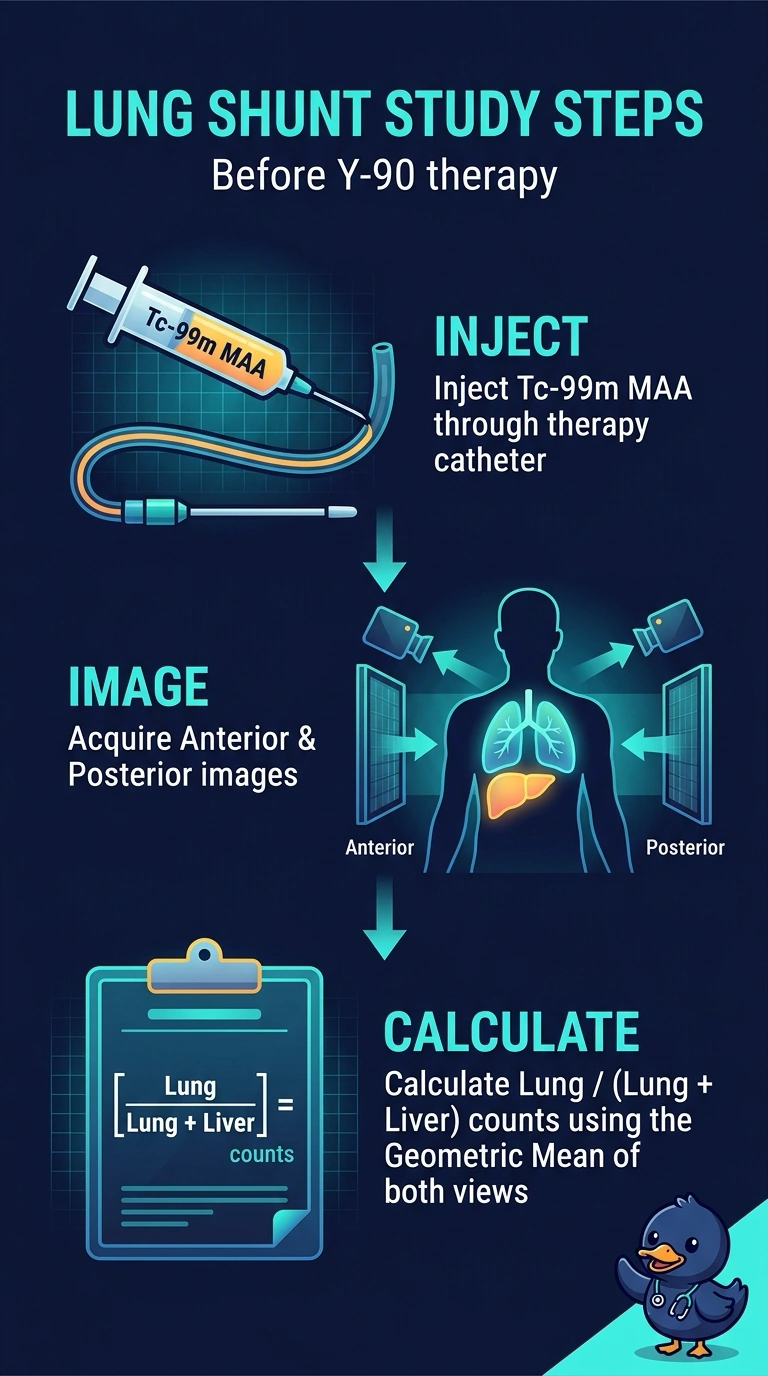
The number only means something if the MAA follows the route the microspheres will take, so you release it from the catheter position planned for therapy. The geometric mean of anterior and posterior counts reduces depth-related error. The lung-plus-liver pairing provides the denominator for the lung shunt fraction.
Full Explanation
The correct plan reproduces the intended microsphere delivery route by injecting Tc-99m MAA through the therapy catheter, so the distribution reflects catheter position and arterial flow at treatment. The geometric mean of anterior and posterior counts reduces the effect of different source depths, and lung counts divided by lung-plus-liver counts gives the lung shunt fraction used in dose assessment. A peripheral IV injection is a familiar route for many radiopharmaceutical studies, but it does not reproduce hepatic arterial delivery; systemic distribution cannot stand in for the catheter-directed MAA distribution. Reporting a lung-to-liver count ratio is also a recognized way to describe relative pulmonary activity, but it is not the requested lung shunt fraction: the liver count alone is the denominator, rather than the combined lung and liver counts, so it cannot be substituted directly for a fraction-based dose calculation. A single anterior image may be used for planar quantification when appropriate corrections are applied, but attenuation correction does not generally cancel depth-related counting differences as the anterior/posterior geometric mean does. Exam caveat: published protocols may use different validated acquisition and calculation conventions, so do not assume every reported ratio is interchangeable with a shunt fraction. Practical check: confirm the catheter position and injection route match the planned treatment, and verify that the calculation worksheet uses geometric-mean lung and liver counts with the intended denominator.