
An outpatient with a palpable thyroid nodule needs gland function quantified before a possible treatment decision. The order calls for an iodine uptake percentage at the department's four-to-six-hour time point, images showing where the tracer localizes, completion in a single visit, and the lowest practical radiation dose. Which thyroid uptake and imaging plan meets all four requirements?
Select an answer to reveal the explanation.
Short Explanation
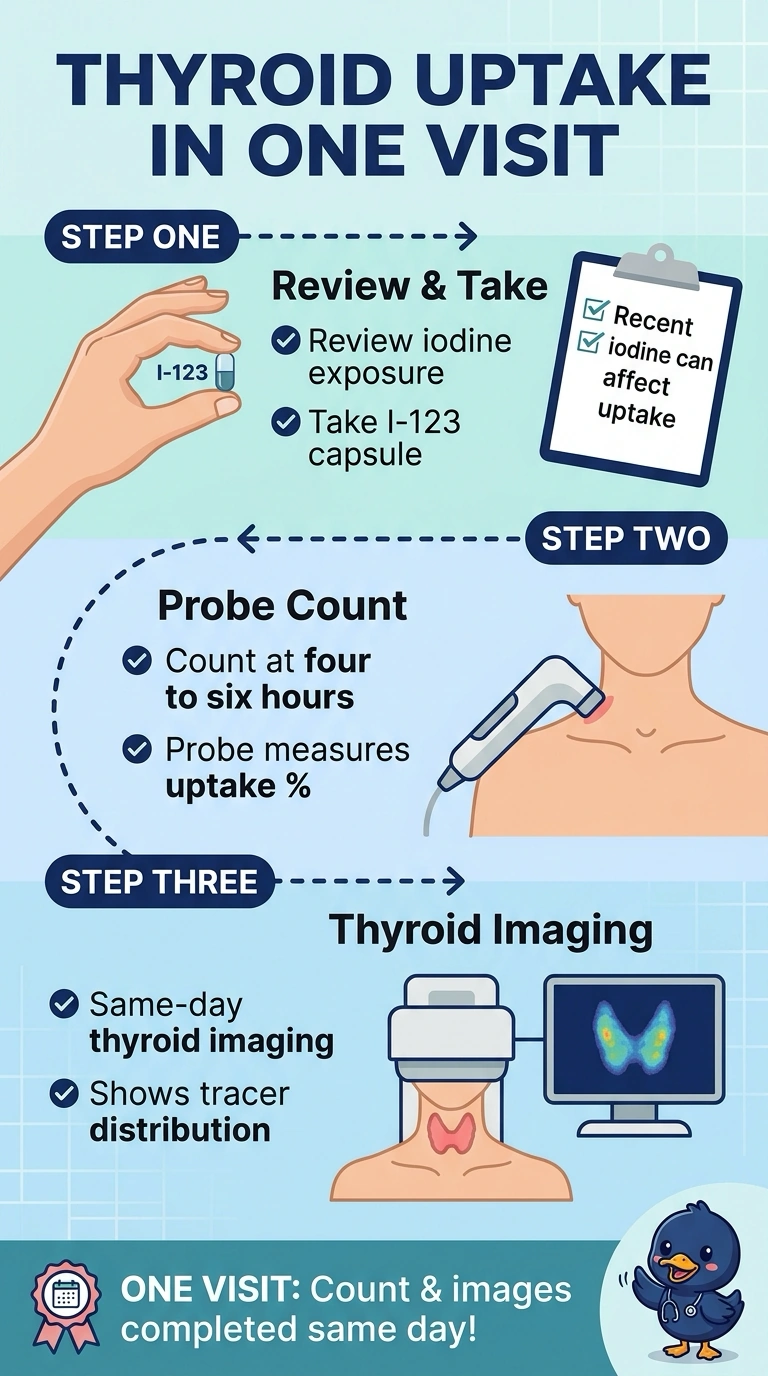
You can use an I-123 capsule for both the uptake measurement and thyroid images in one visit—like getting two readings from the same tracer. A probe measurement at four to six hours meets your timing requirement, and I-123 keeps your radiation dose low.
Full Explanation
I-123 is suitable for diagnostic thyroid uptake measurement and imaging, and a four-to-six-hour measurement with same-day imaging can meet the stated single-visit requirement. Uptake is calculated using the patient's thyroid counts and appropriate standard and background measurements. Tc-99m pertechnetate is trapped by the thyroid but is not organified, so its uptake measurement is not an iodine uptake percentage. A twenty-four-hour I-123 measurement would not meet the single-visit requirement as stated. I-131 is generally not preferred for this diagnostic study because its beta emission results in a higher thyroid radiation dose than I-123. Recent iodine exposure, including iodinated contrast or iodine-containing medicines, can affect uptake; relevant history should be reviewed and preparation should follow the department's protocol.