
A department prepares the same technetium-99m kit throughout the day, adjusting each draw for decay so every kit receives the target activity. Batches made late in the afternoon label less efficiently than morning batches, although all draws come from the same eluate held since the morning and eluate pH, incubation temperature, and incubation time stay within the package insert ranges. Which remaining preparation variable best explains the drop in labeling efficiency?
Select an answer to reveal the explanation.
Short Explanation
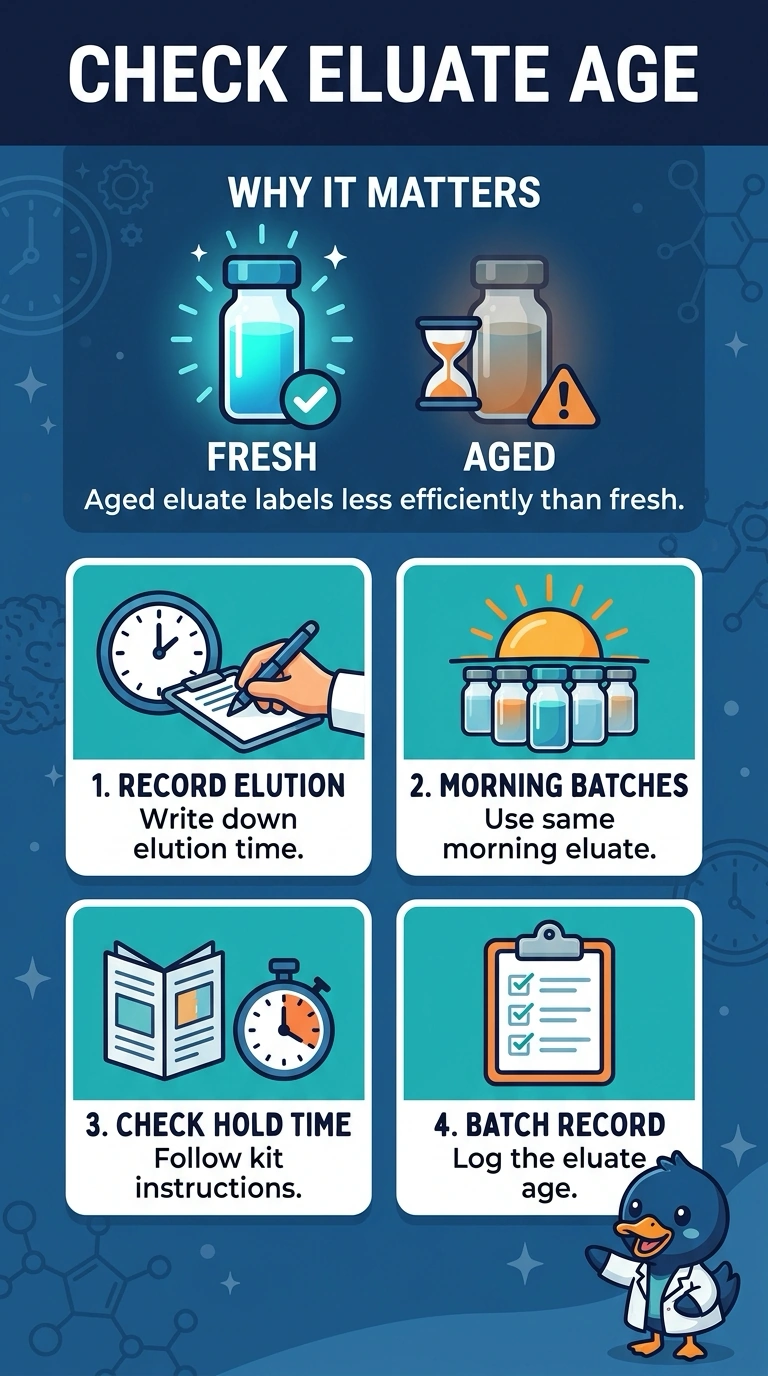
Your eluate is like a fresh ingredient: the longer it sits, the less efficiently it may work in the kit. Since you kept pH, temperature, and incubation time within range, check how long the eluate was held and follow the kit instructions.
Full Explanation
The eluate’s age is the remaining variable that changes systematically across the day: every batch uses material held since morning, so later preparations use older eluate even though their activity is decay-adjusted. Eluate age can affect labeling performance; meeting the target activity does not make an aged eluate equivalent to a fresh one. Reassaying activity and adjusting eluate volume is a standard way to control the activity delivered to a kit, but it does not address the stated fact that the target activity is already met, nor does it correct age-related effects. Measuring and adjusting reaction pH is a valid control when pH is out of range, but the scenario states that pH complies, so this does not explain the observed decline. Choosing an insert-validated incubation window can support complexation when time is inadequate; here, incubation time already complies, so extending it does not address the changing eluate age. Exam caveat: a compliant pH, activity, and incubation time do not guarantee acceptable labeling yield, and other kit-specific factors may matter in practice. Practical check: compare labeling efficiency using fresh and held eluate under otherwise matched conditions, while documenting elution time and following the kit insert and local quality-control procedures.