
During a busy afternoon, a visitor stays at a seated patient's side for three hours after a Tc-99m injection. The visitor is a family member rather than staff, arrives without a personal dosimeter, and a survey estimates 45 mrem to the whole body for the visit. The radiation safety officer is reviewing the log. Which regulatory dose limit should the officer compare the 45 mrem against?
Select an answer to reveal the explanation.
Short Explanation
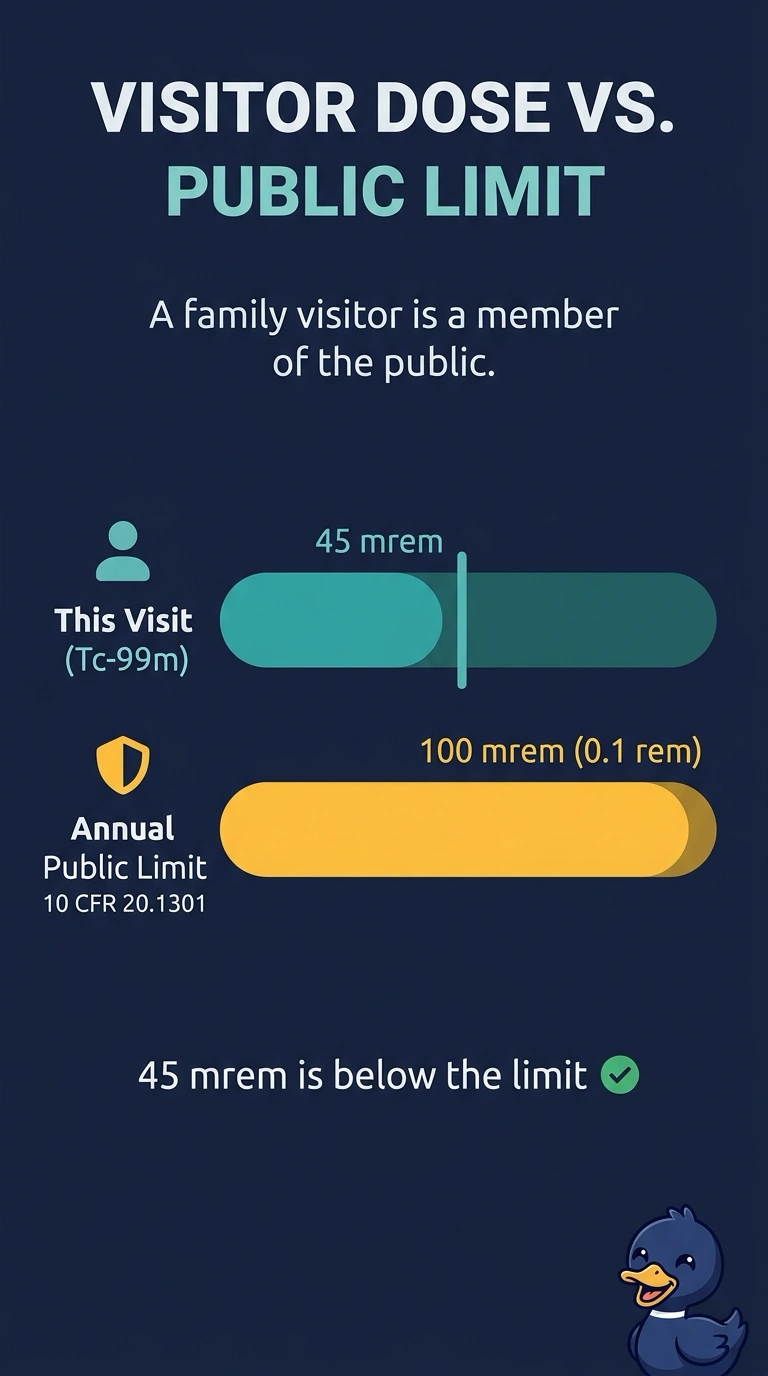
The visitor is a member of the public, so you compare the 45 mrem with the 100 mrem annual public dose limit in 10 CFR 20.1301. The exclusion for patients applies only after a patient has been released under 10 CFR 35.75, and this patient is still in your department. The visit is within the limit.
Full Explanation
A family member visiting a patient in the department is a member of the public, so the relevant benchmark is the 0.1 rem (100 mrem) annual total effective dose equivalent limit in 10 CFR 20.1301(a)(1). The regulation excludes dose from individuals administered radioactive material only when they have been released under 10 CFR 35.75; this patient has just been injected and has not been released, so the exclusion does not apply. The estimated 45 mrem is below 100 mrem. If a visit were expected to exceed 100 mrem with a patient who cannot be released, 20.1301(c) allows up to 0.5 rem only when the authorized user determines before the visit that it is appropriate. The 5 rem annual limit and the 50 rem shallow-dose limit are occupational limits for radiation workers, and the 0.5 rem embryo/fetus limit applies to a declared pregnant worker, so none of them applies to a visitor. A missing personal dosimeter does not change which limit applies; it only means the dose must be estimated from survey data, as was done here.