
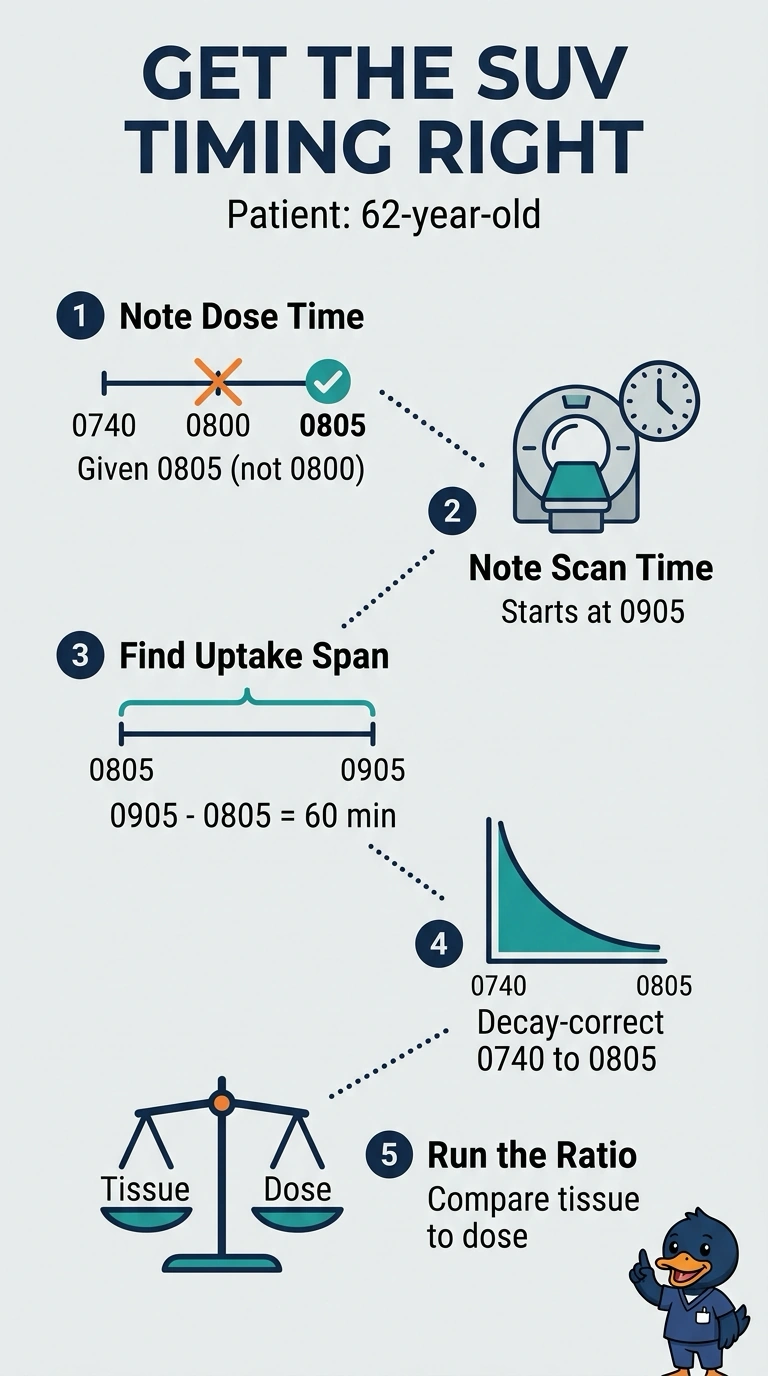
A 62-year-old outpatient arrives for an FDG PET study at 0800. The dose is given at 0805, but the injection time was entered as 0740, and the camera begins at 0905. Blood glucose is logged and the patient's weight is current. The radiologist wants accurate SUV values before the report is released. Which correction should the technologist make to the study record before the SUV is calculated?
Select an answer to reveal the explanation.
Short Explanation
Correct the injection time to 0805 before you calculate the SUV. Your timestamp is like the starting point on a clock—it determines dose decay correction and the uptake interval.
Full Explanation
SUV is calculated from tissue activity concentration relative to administered activity normalized to a patient-size measure. The administered activity must be decay-corrected to the appropriate reference time, and the recorded injection time is also used to determine the injection-to-scan interval. Correcting the time entry is therefore necessary for accurate quantification and accurate uptake-time documentation. The patient's weight is already current, and rechecking it would not correct the timing error. Blood glucose can affect FDG biodistribution and is relevant to image interpretation, but repeating the measurement would not correct the erroneous injection time. Confirming dose calibrator cross-calibration is useful quality control, but it would not correct the timing error. Verify the injection time against the source record before releasing quantified results.