
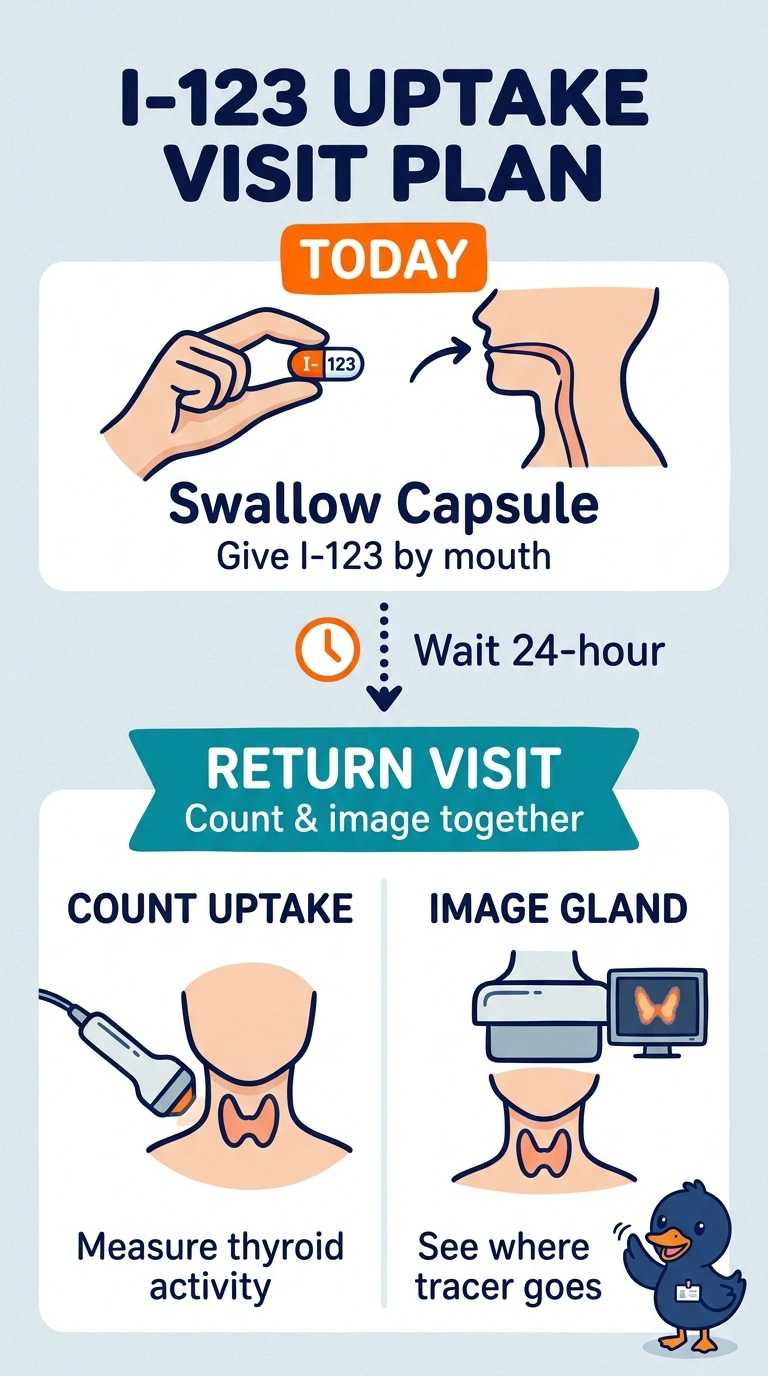
A patient with a palpable thyroid nodule and a suppressed TSH arrives for a thyroid study. The signed order calls for an oral I-123 capsule, a 24-hour uptake measurement, and an image showing which region of the gland traps tracer, and the patient reports stopping seafood and multivitamins three weeks ago. Which visit plan matches this thyroid uptake and imaging order?
Select an answer to reveal the explanation.
Short Explanation
The order asks for an oral capsule, a 24-hour uptake count, and an image of tracer distribution, so you'll need one visit plan that delivers all three. Trying to stretch a short-lived tracer across a full day is like timing a bake with a sparkler instead of an oven clock. The 24-hour uptake count is the anchor of this study.
Full Explanation
I-123 is taken by mouth for an uptake study, and its physical half-life supports counting a full day later, so the capsule, the delayed count, and imaging during that same return visit form one coherent protocol. The delayed image also shows which region traps tracer, the detail that helps distinguish a hot nodule from a cold one. The pertechnetate approach fails on physics, because technetium-99m decays too quickly to yield a meaningful 24-hour uptake value, and it measures trapping alone rather than the quantitative uptake the study needs. The immediate-image approach pictures the capsule while it still sits in the gastrointestinal tract, so the activity you see comes from the stomach and esophagus instead of the gland. The count-only approach delivers the number but drops the imaging requirement, leaving the nodule's functional behavior uncharacterized. Exam caveat: interference rules and hold intervals vary by protocol, so confirm the department's current hold list rather than memorizing a single number. Practical check: before the capsule is swallowed, confirm that the count appointment and the imaging slot fall on the same visit.