
A community hospital wants F-18 FDG PET for 8:00 AM weekday patients but cannot buy a cyclotron, and the nearest producer is two hours away by road. F-18 has a half-life of about 110 minutes. Which supply plan fits this schedule?
Select an answer to reveal the explanation.
Short Explanation
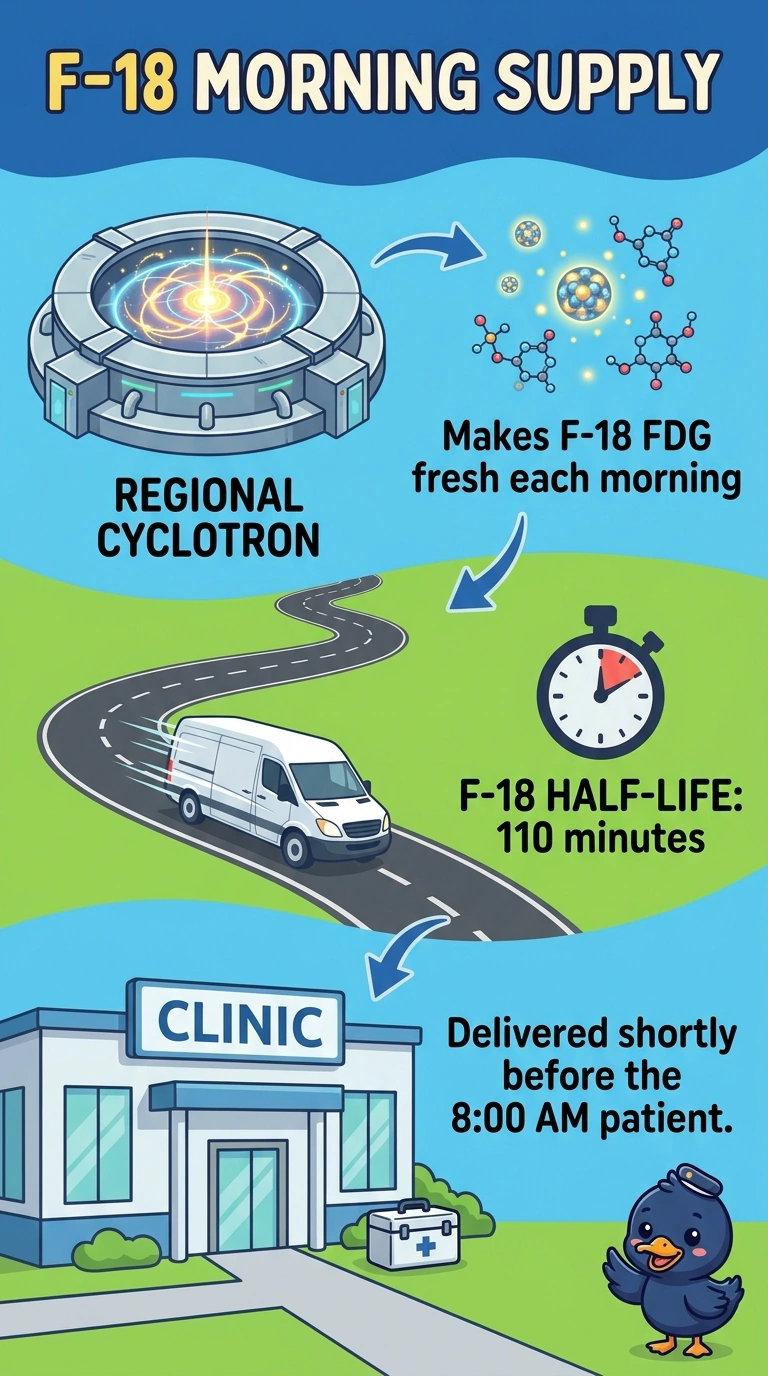
You need FDG made close to appointment time because F-18 loses activity quickly, so a regional cyclotron with delivery shortly before the first patients is a good fit. A batch that arrives after appointments start or a route that takes two hours misses the schedule, and sodium fluoride is not FDG; timing matters.
Full Explanation
A regional cyclotron can make F-18 FDG each morning and deliver it shortly before the 8:00 AM patients, meeting the schedule without requiring the hospital to buy a cyclotron. With a half-life of about 110 minutes, minimizing the time from production to administration preserves usable activity. A dawn batch that arrives after appointments begin is too late for those patients, even if it was produced that morning. A supplier’s FDG route that arrives only after its two-hour road trip also fails if that arrival is after the 8:00 AM appointments; the relevant issue is when the dose is ready for use, not simply when the route departs. F-18 sodium fluoride is a different radiopharmaceutical, used for bone imaging, and cannot substitute for FDG in scheduled FDG PET scans. The exam caveat is that “morning production” by itself does not guarantee a workable supply: production, transport, and the patient schedule must be coordinated around radioactive decay. In practice, check the producer’s dispatch time, route reliability, expected activity on arrival, and the time the hospital needs to receive, prepare, and administer the doses.