
A physician orders a thyroid study for a patient with a palpable nodule that must provide quantified iodine uptake at two time points plus morphologic images; the patient can attend on two consecutive days. Which radiopharmaceutical and timing plan meets these requirements?
Select an answer to reveal the explanation.
Short Explanation
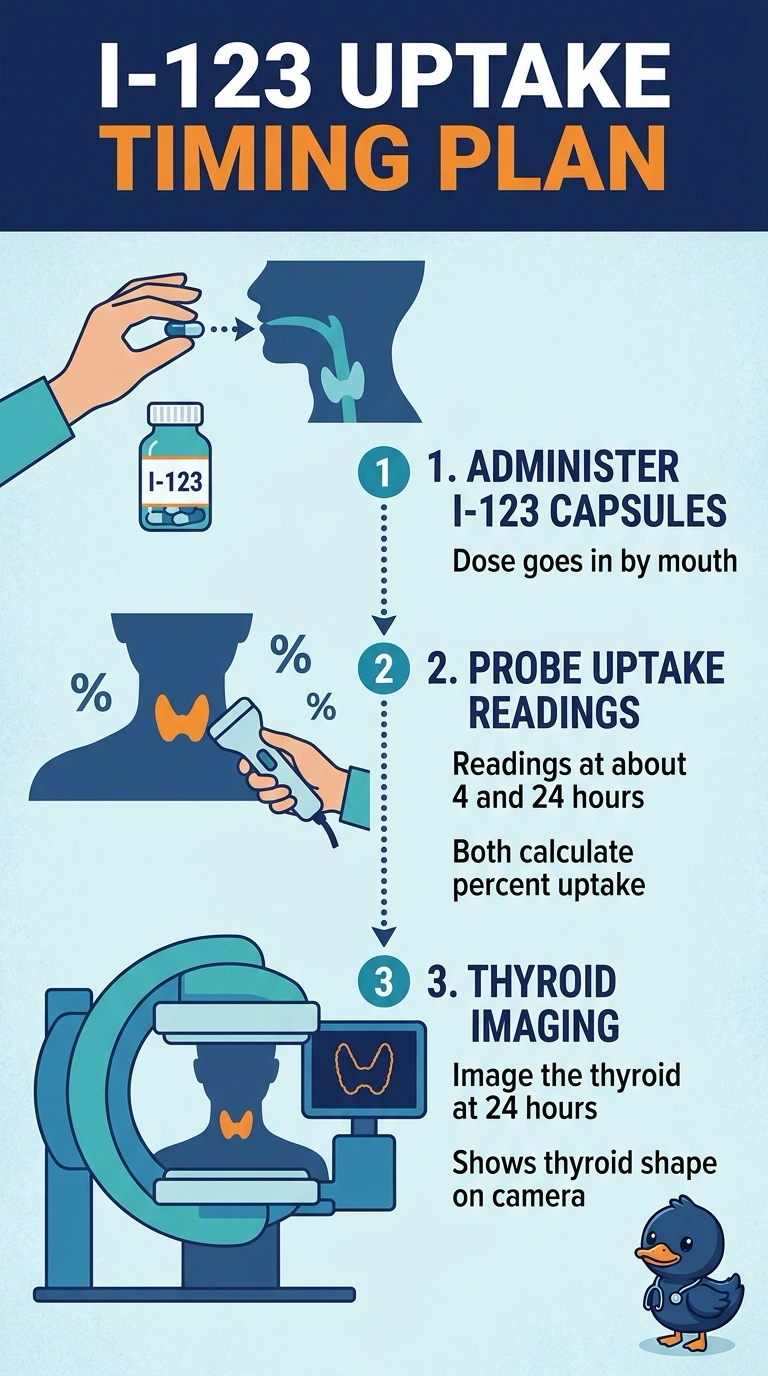
You’ll give I-123 capsules, measure uptake with a probe at about 4 and 24 hours, and image the thyroid at 24 hours. It’s like checking the clock twice before taking a picture—you get both uptake readings and a view of the gland.
Full Explanation
I-123 behaves like stable iodine, so it is trapped and then organified by the gland, and each uptake probe reading reports the fraction of administered activity the thyroid actually accumulated. Taking readings at roughly four hours and at twenty-four hours gives the trend clinicians use to separate high from low uptake states, and imaging at the second visit supplies the morphologic map in the same study. Tc-99m pertechnetate is trapped but not organified and clears quickly, so it delivers a fine early image yet cannot produce paired iodine uptake values, missing the quantification requirement. Imaging with I-123 while skipping probe measurements yields pictures without numbers, which misses the quantified uptake requirement entirely. A single four-hour reading satisfies the tracer choice but never reaches the second time point, so the two-point requirement is unmet. Exam caveat: exact intervals vary slightly among protocols, so recognize the two-point concept rather than one clock time. Practical check: record any recent iodine contrast, supplements, or thyroid medications before dosing, since they shift uptake values.