
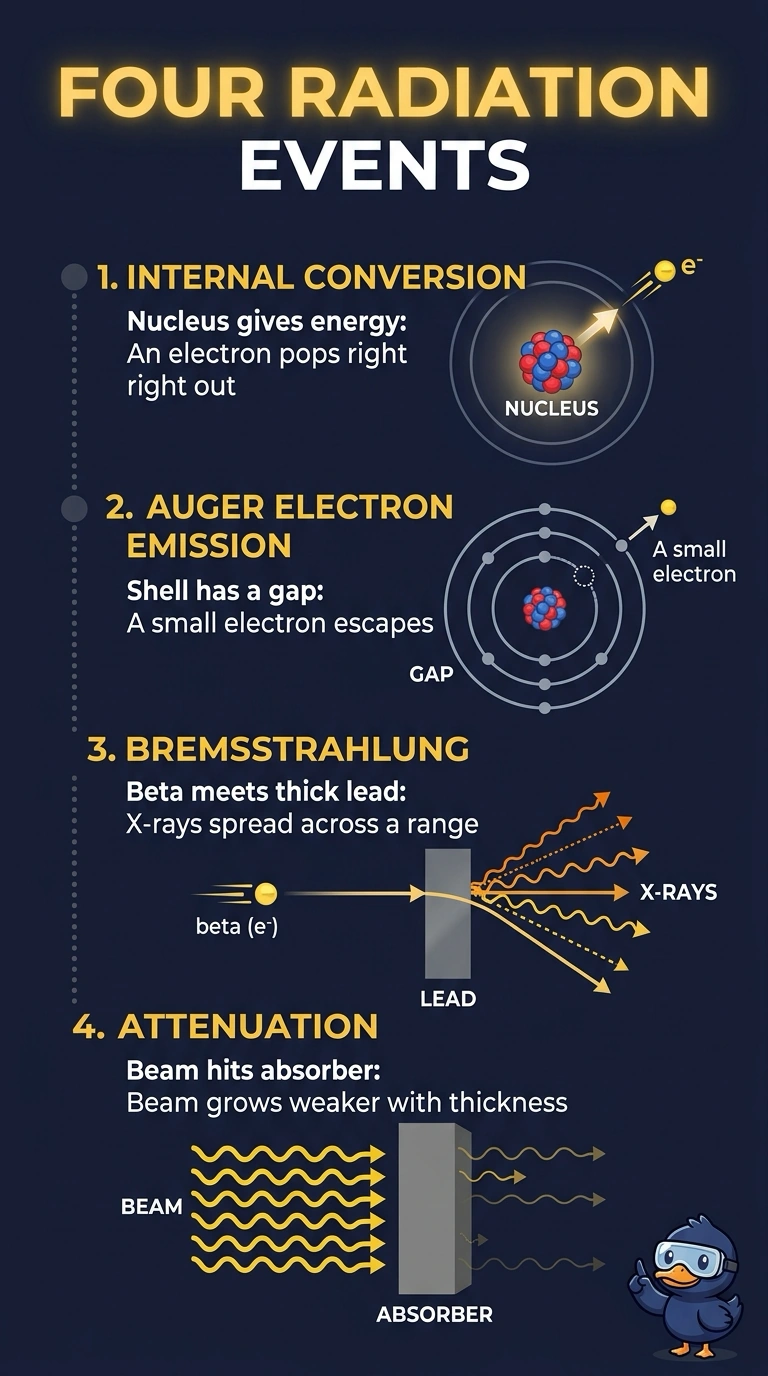
A physics resident logs four observations: a Tc-99m nucleus passes its excitation energy to an inner orbital electron, an inner-shell vacancy is followed by low-energy electron emission, beta particles stopped in thick lead create a broad x-ray continuum, and a gamma beam weakens exponentially as absorber thickness grows. Which radiation physics phenomenon accounts for each observation in order?
Select an answer to reveal the explanation.
Short Explanation
You can follow the sequence like a chain of events: internal conversion transfers nuclear energy to an electron, then Auger electron emission fills the shell vacancy. Next, stopped beta particles produce bremsstrahlung, and the beam’s exponential weakening is attenuation—you’ll see them in that order.
Full Explanation
Internal conversion is a decay event: the excited nucleus transfers energy directly to an inner orbital electron and ejects it, so the electron leaves with a discrete energy instead of a gamma ray. Auger emission happens when the vacancy left in an inner shell is filled and part of the released energy kicks out a low-energy electron with very short range and heavy local deposition. Bremsstrahlung is a shielding issue, because a beta particle decelerating in the field of a high-atomic-number nucleus radiates a continuous spread of photon energies. Attenuation is a beam property, describing exponential removal of photons through an absorber by photoelectric absorption, Compton scattering, coherent scattering, and pair production. Lead characteristic x-rays fail the continuum requirement because fluorescence leaves at discrete line energies. Photoelectric absorption fails the decay-mechanism requirement, since it is an interaction between a photon and atomic electrons instead of a nuclear transition. The inverse-square law fails the absorber requirement, because it describes geometric spread with distance, unchanged by added absorber. Exam caveat: beta shielding is often tested as low-atomic-number backing first, with lead behind it to catch the bremsstrahlung. Practical check: if a survey reading jumps after lead is added around a beta source, suspect bremsstrahlung before a detector fault.