
A 38-year-old with a palpable thyroid nodule is booked for a 24-hour iodine-123 uptake study with planar imaging, with Tc-99m pertechnetate uptake imaging available as a backup method. The chart documents intravenous iodinated contrast earlier this month and daily kelp supplements. Which iodine-related preparation requirement must be confirmed before the capsule or the pertechnetate dose is given?
Select an answer to reveal the explanation.
Short Explanation
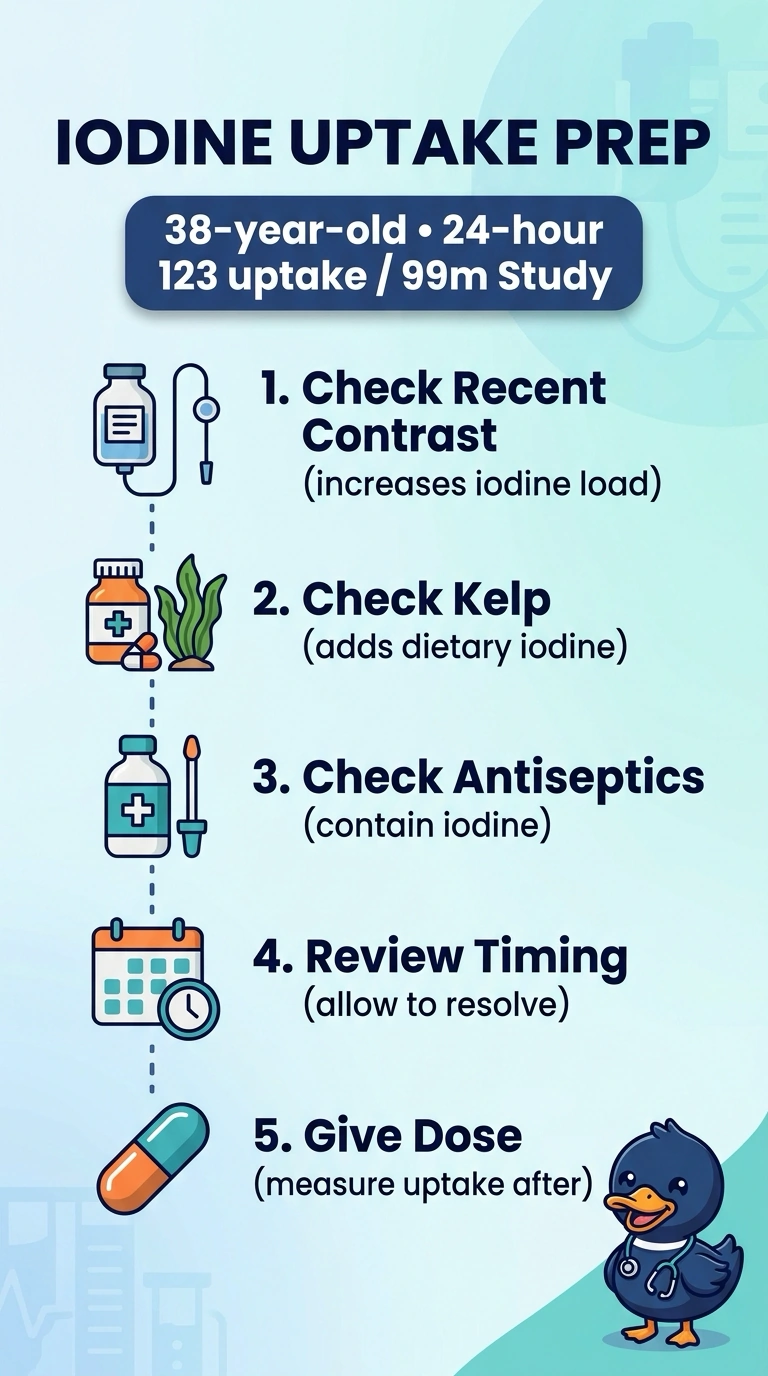
Before you take the capsule or pertechnetate dose, make sure your recent contrast and kelp exposure has had enough time to clear: they can add to your iodine load and suppress thyroid uptake. It’s like adding extra weight to a scale, so the result may look low; the needed wait depends on your exposure and circumstances, not a fixed number of days.
Full Explanation
The required check is whether the documented iodine sources—intravenous iodinated contrast and daily kelp—have supplied enough iodine to suppress thyroid trapping and make the uptake result unreliable, and whether sufficient time has passed for that effect to resolve. This matters before either study method: I-123 uptake depends on thyroid trapping and organification, while pertechnetate uptake also depends on trapping, so substituting pertechnetate does not bypass an iodine load. Withholding thyroid-active medication can be appropriate in some protocols, but it does not establish that exogenous iodine has cleared. A low-iodine diet is a useful preparation measure, yet reported adherence does not determine the clearance interval after contrast or ongoing kelp use. Choosing pertechnetate avoids administering an iodine isotope, but it does not prevent excess stable iodine from affecting thyroid uptake. Exam caveat: required waiting periods vary with the iodine source, dose, renal clearance, and local protocol, so a fixed interval should not be assumed. Practical check: document the dates of contrast and last kelp use, review relevant medications and renal status, and confirm the department’s clearance criteria before dosing; if they are not met, discuss postponement with the interpreting physician.