
A technologist draws a Tc-99m dose that reads 800 MBq at 7:00 AM for a patient booked at 1:00 PM, and the appointment slips to 7:00 PM with no fresh dose available. The same syringe will be used, and the department logs the activity at administration. What activity should be documented when the patient is injected at 7:00 PM?
Select an answer to reveal the explanation.
Short Explanation
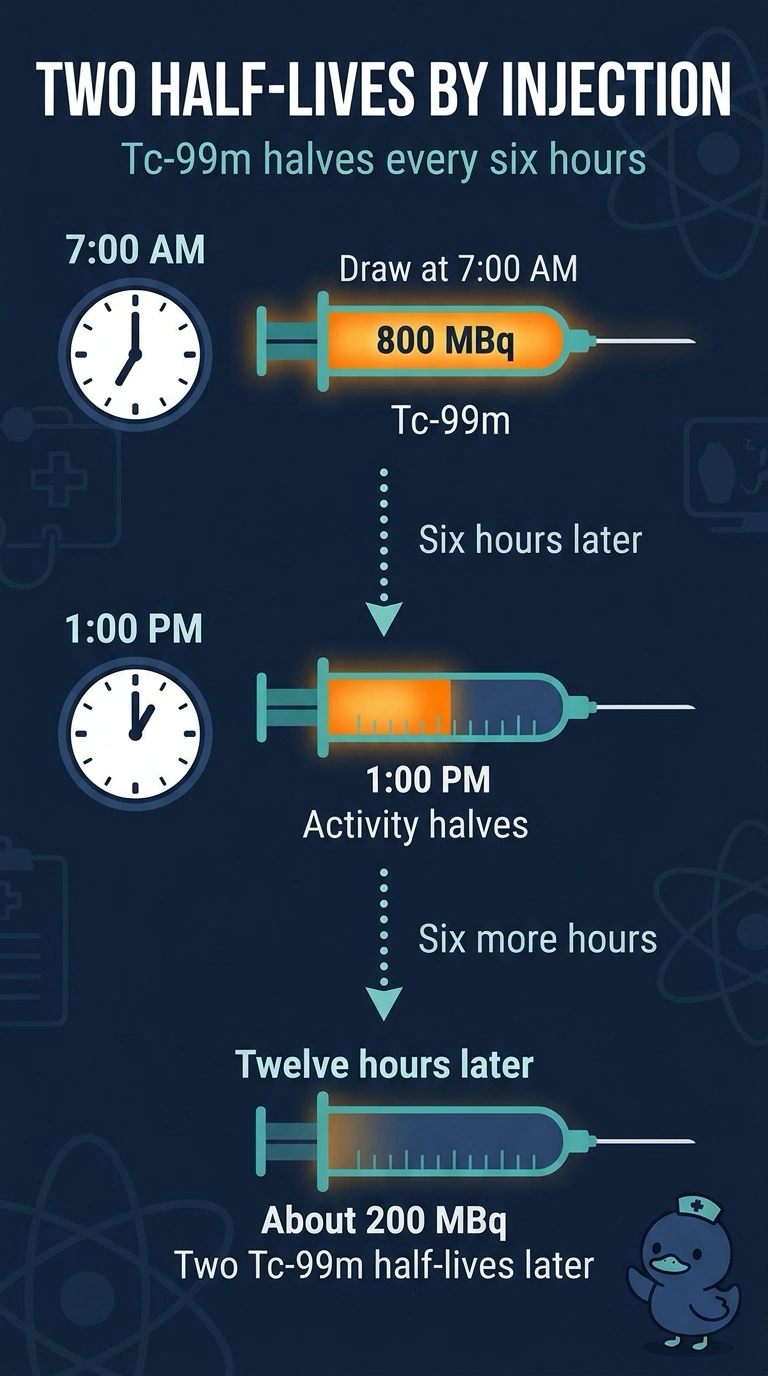
By 7:00 PM, 12 hours have passed—two Tc-99m half-lives—so your 800 MBq dose has halved twice, like a quantity split in half two times, leaving about 200 MBq. You should document the activity at injection, not the amount at the original appointment time.
Full Explanation
Decay is exponential and depends only on elapsed time, so activity at administration is determined by how many physical half-lives separate the draw from the injection. Tc-99m has a half-life of about six hours, and seven in the morning to seven at night is twelve hours, or about two half-lives: 800 MBq halves to 400 MBq and then to 200 MBq. Counting only the interval to the original 1:00 PM appointment yields 400 MBq, a correct calculation applied to the wrong clock. Treating twelve hours as three half-lives miscounts the time and gives 100 MBq. A dose calibrator normally indicates activity at the time of measurement unless decay correction is specifically applied. Residual activity and measurement geometry can affect the measured activity, so follow departmental procedures for documenting administered activity.