
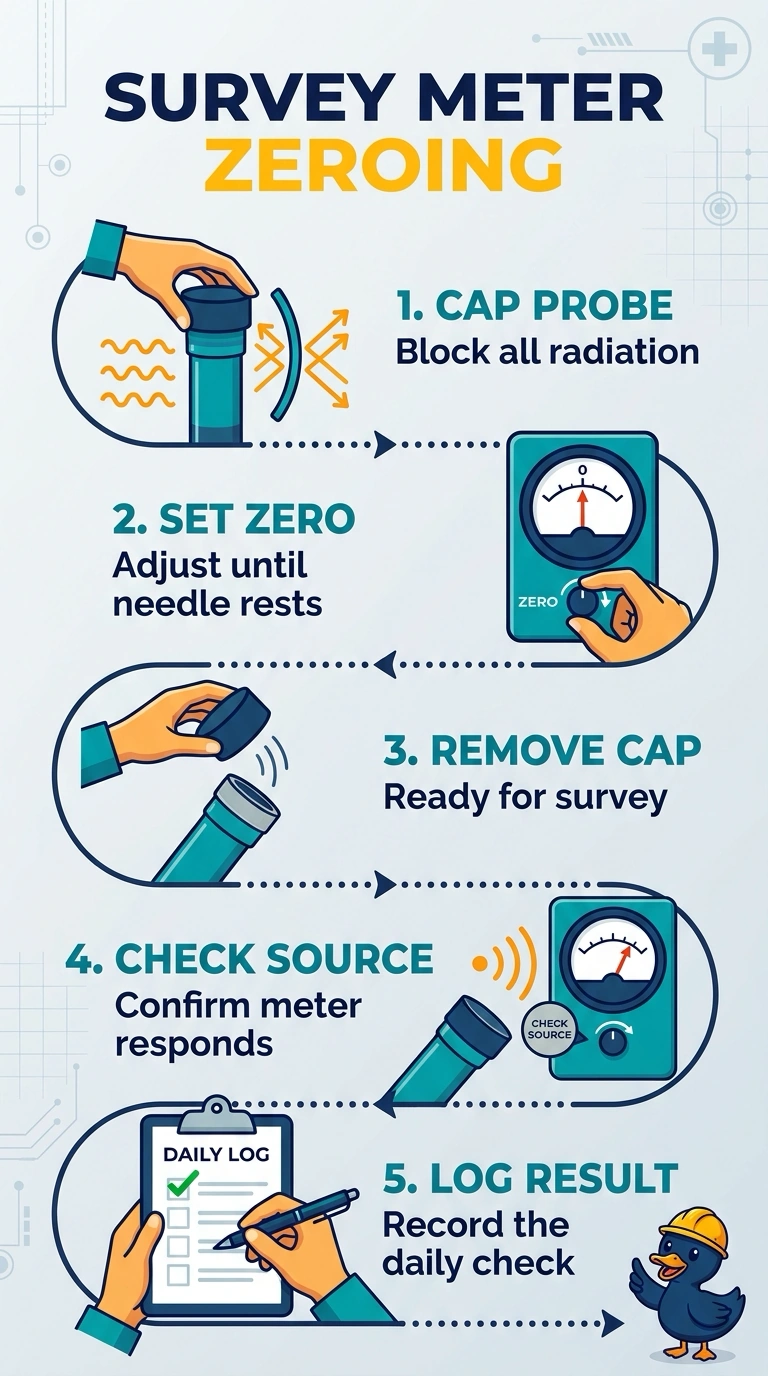
Before the day's Tc-99m workload, a technologist checks two survey meters. With both probes capped the ionization chamber needle sits above zero while the GM meter already reads zero, and the SOP requires each meter to indicate zero before the first survey. Which first step makes the ionization chamber ready for use?
Select an answer to reveal the explanation.
Short Explanation
With the probe capped, you expect the ionization chamber to indicate zero, so an above-zero needle needs correcting before the first survey. Set the zero control with the cap on, then use the sealed check source to confirm the chamber responds.
Full Explanation
The capped ionization-chamber reading is above zero, so the meter is not ready under the SOP. Zeroing it with the probe capped corrects its zero indication under the specified condition; confirming its response to the sealed check source then provides an operational check before use. Zeroing the chamber uncapped in the survey area does not meet the required capped-zero condition, because the probe is exposed to radiation during adjustment. Zeroing the capped chamber and then checking it in the ambient radiation field uses the correct zeroing condition, but an ambient field is not the specified sealed check source and may vary with location and time, so it does not establish the requested response check. Checking the sealed source before zeroing the capped chamber reverses the required order: the known zero offset remains uncorrected during the response check, so this does not make the chamber ready as the first step. Exam caveat: follow the specific meter’s manual and local SOP, since zero controls and check-source acceptance criteria vary by model. Practical check: after zeroing, confirm the capped indication remains at zero and the sealed-source response falls within the instrument’s documented acceptance range; investigate a failed check before surveying.