
PACS becomes unavailable while two SPECT studies are being processed, and the radiologist still needs both images for same-day interpretation. Which downtime workflow keeps the studies identifiable, readable today, and fully accounted for after recovery?
Select an answer to reveal the explanation.
Short Explanation
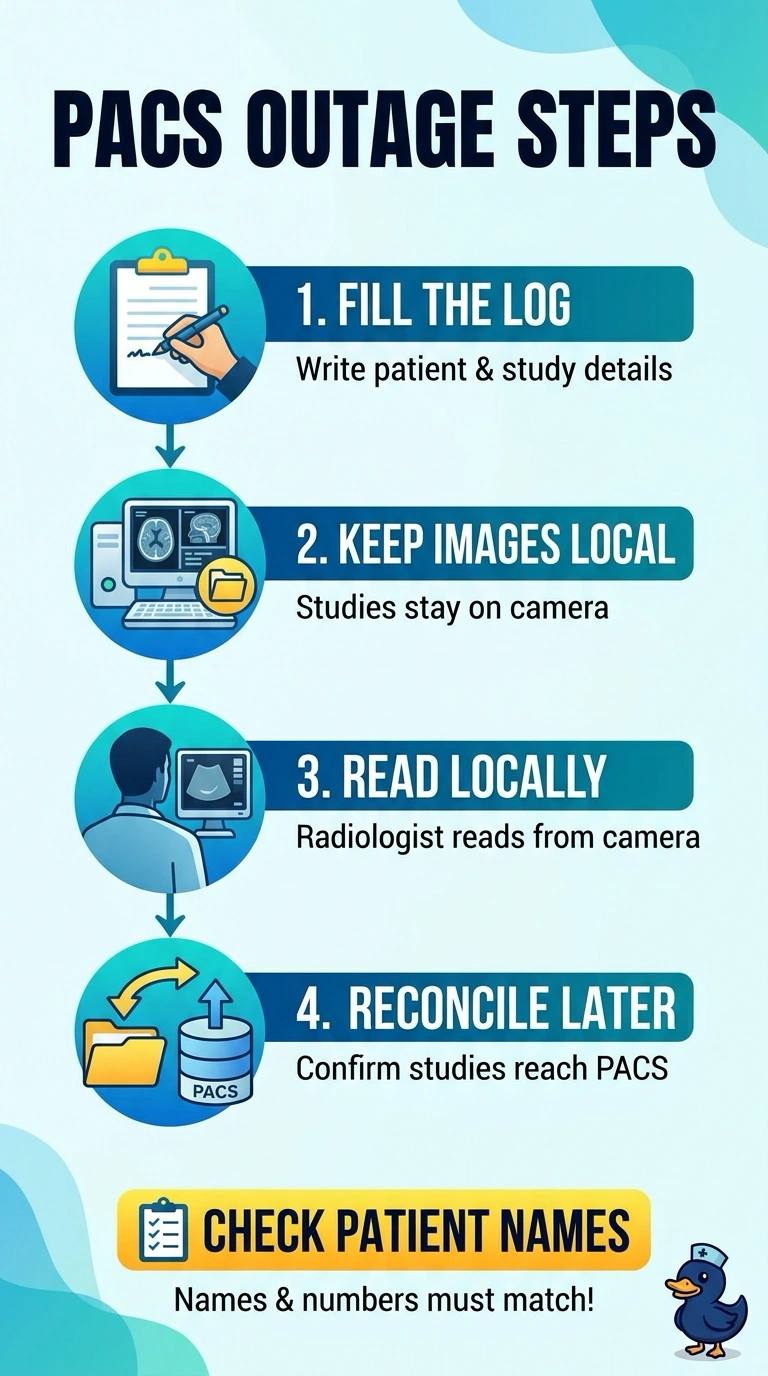
An outage changes where images live, not what you owe the radiologist, so you can keep reading while preserving a paper trail. The downtime form helps you account for both studies while the images remain local for today’s interpretation. Don’t rely on queued sends or informal identification alone to close the loop.
Full Explanation
Logging both studies on the downtime form, keeping their images local for same-day reading, and reconciling them into PACS after recovery preserves identification, readability, and accountability. Checking identifiers and reading locally today are useful, but trusting PACS auto-forwarding without confirming arrival leaves no proof that both studies reached PACS and were matched correctly. Logging the studies, reading locally, then deleting local copies when PACS accepts a queued transfer is also insufficient: queue acceptance does not confirm complete, readable images, and deleting the local copies can remove a dependable way to resolve a failed or incomplete transfer. Logging by name and MRN, reading locally, and reconciling after recovery using demographics alone preserves the local images and a record, but those demographics may not uniquely distinguish multiple studies for one patient; reconciliation needs study-level identifiers or an equivalent reliable crosswalk. Exam caveat: a successful transmission or queue status is not necessarily proof that the correct, complete study is visible in PACS. Practical check: after recovery, compare each downtime entry with the PACS patient and study identifiers, confirm image completeness and readability, and document reconciliation before closing the downtime record.