
A technologist starts a gated SPECT myocardial perfusion acquisition and sees the cycle-length histogram spread widely instead of clustering around one R-R interval; the chest leads were applied over lotion, and the study must finish before the stress lab opens. Which correction should the technologist make before restarting the gated acquisition?
Select an answer to reveal the explanation.
Short Explanation
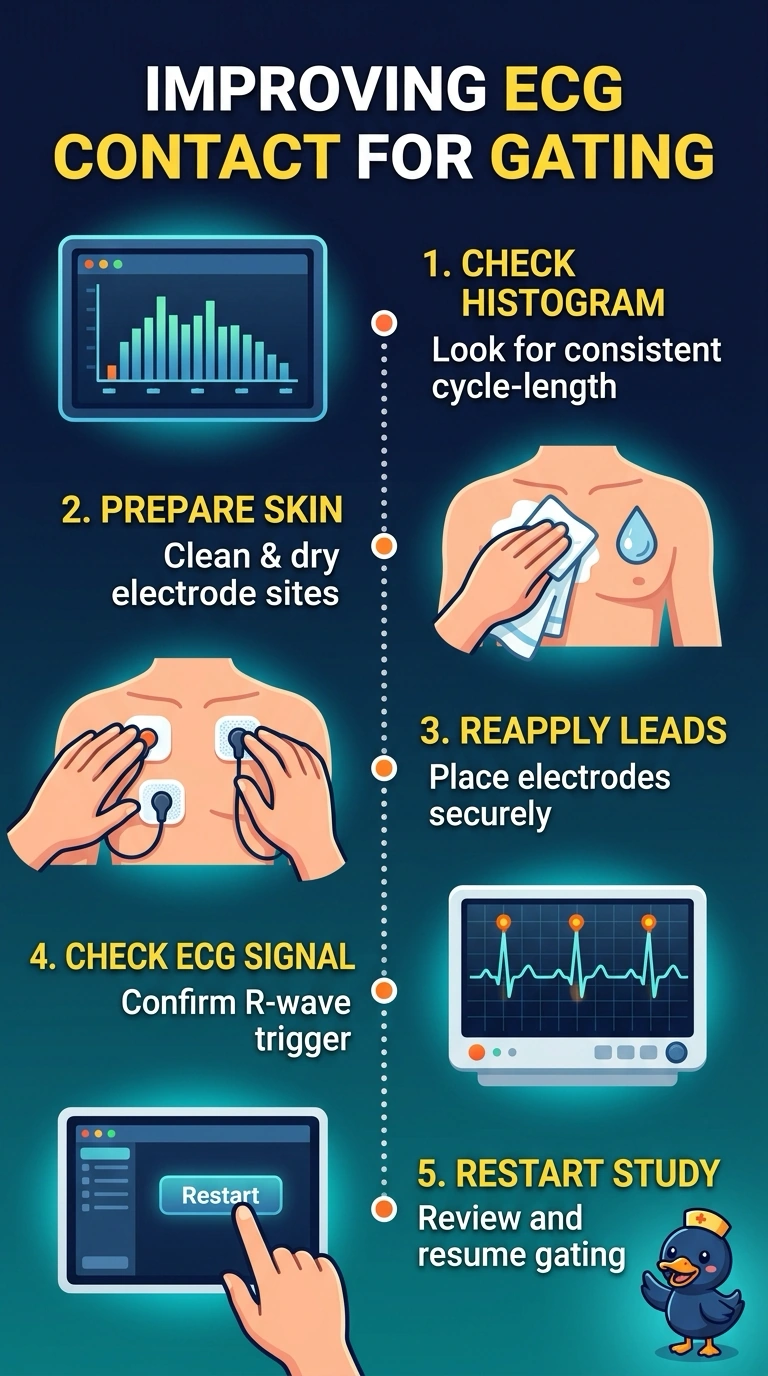
Lotion can weaken electrode contact, much like a loose connection disrupting a signal. Clean and dry your skin, then reapply the leads so the R-wave trigger is reliable before you restart the gated acquisition.
Full Explanation
The wide cycle-length histogram suggests inconsistent R-wave triggering, so address the ECG signal at its source before restarting. Lotion beneath the chest electrodes can impair skin contact; remove the leads, clean and dry the skin, and reapply them to help produce a reliable signal. Checking R-wave polarity and adjusting the trigger threshold can help when settings cause mis-triggering, but these changes cannot correct poor electrode contact. Widening the accepted R-R interval window may retain more beats when confirmed ectopy or sinus arrhythmia causes genuine variability, but it does not fix the stated skin-preparation problem and may admit a broader range of cardiac phases. Trying an alternate lead vector or refining trigger sensitivity may be useful for some signal problems, but leaving the lotion-covered electrodes in place does not restore reliable contact. Exam caveat: a broad histogram can reflect true rhythm variability or poor triggering, so assess the ECG trace and patient rhythm rather than assuming the cause from the histogram alone. Practical check: after reapplying the leads, confirm a stable R-wave signal and a tighter cycle-length histogram before restarting.