
During quality control in a hospital radiopharmacy, one result shows that a freshly eluted Tc-99m generator sample is within its molybdenum breakthrough limit, and a second shows that a sulfur colloid preparation contains no free pertechnetate. Which type of purity does each result verify?
Select an answer to reveal the explanation.
Short Explanation
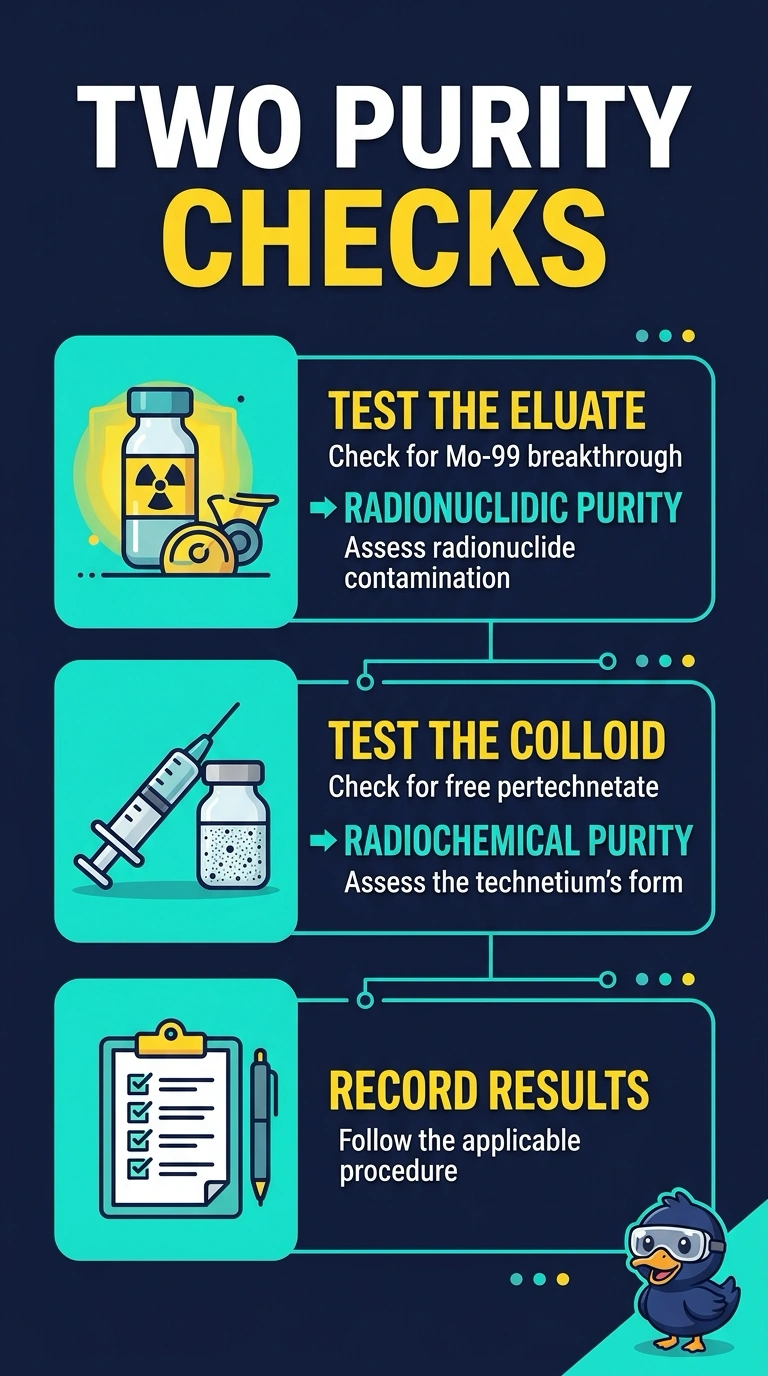
For the generator eluate, you’re checking radionuclidic purity—like screening for the wrong radioactive passenger—by measuring molybdenum breakthrough. For the colloid, you’re checking radiochemical purity by confirming the technetium is in its intended form, not free pertechnetate.
Full Explanation
Radionuclidic purity concerns the presence of radionuclides other than the radionuclide of interest, such as Mo-99 in a Tc-99m generator eluate. A result within the applicable breakthrough limit indicates that the measured Mo-99 contamination is acceptable. Radiochemical purity concerns the chemical or physical form of the radionuclide. Free pertechnetate in a sulfur colloid indicates that some technetium is not incorporated into the colloidal form; it may distribute differently from the particles, which are taken up by the reticuloendothelial system. Particle-size distribution is a separate physical attribute. Aluminum-ion testing assesses chemical purity, not radionuclidic purity. Applicable limits, methods, and testing frequencies depend on current requirements and product instructions.