
After a photomultiplier tube was replaced on one gamma camera head, the service engineer adjusted the gain and asked for quality control before the camera returns to clinical use. Which test will show whether every region of the detector responds evenly to a uniform radioactive source?
Select an answer to reveal the explanation.
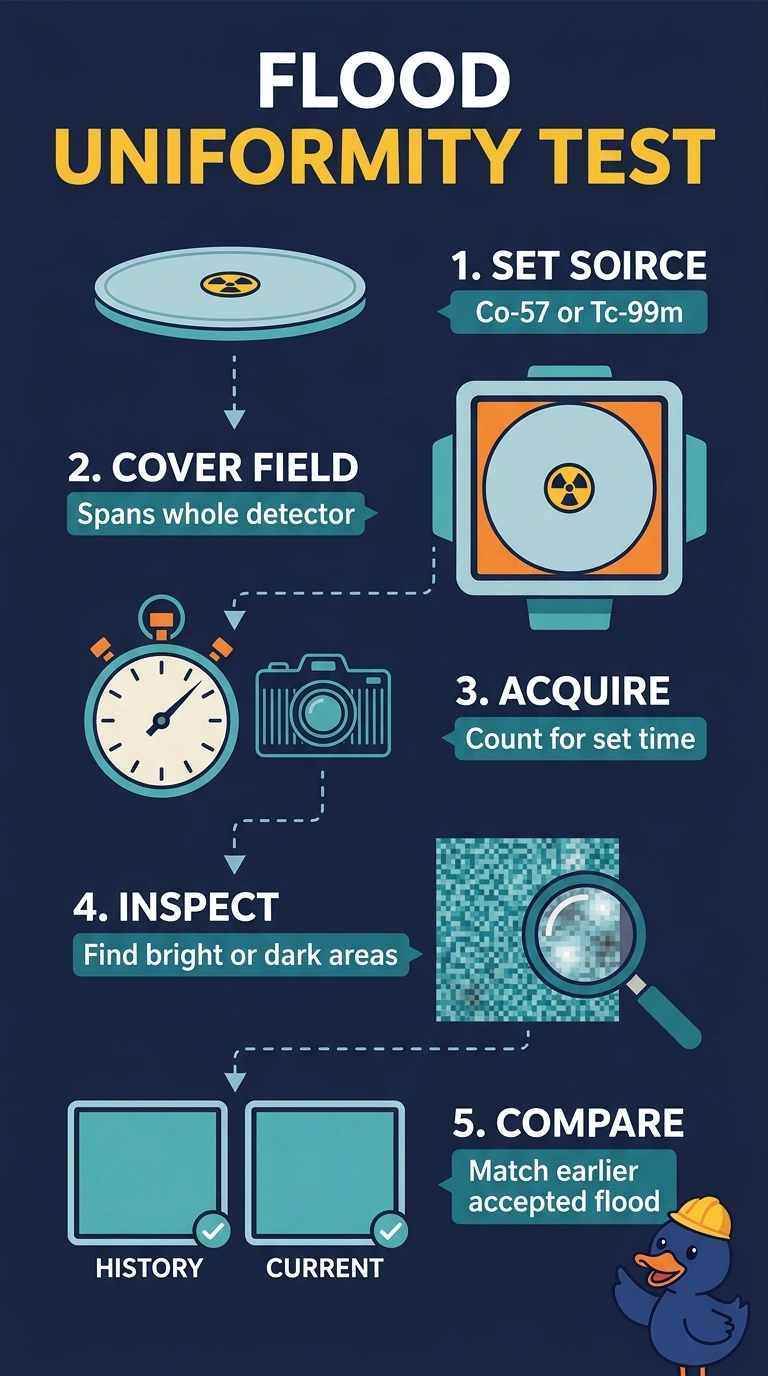
Short Explanation
A uniform flood tells you whether every part of the detector counts the same amount from an even source, which is exactly what a swapped tube disturbs. It works like a tire-pressure check: the bar phantom measures shape, and the flood measures evenness. That's why flood field uniformity is the test you run first.
Full Explanation
Flood field uniformity is the direct measure of even response, because a uniformly distributed source should produce an evenly counted image across the whole detector, and any gain shift left by a replaced photomultiplier tube shows up as a regional bright or dark area. The bar and linearity phantom approach evaluates geometric performance instead, telling you whether lines stay straight and spaces stay even rather than whether counts match from region to region. The center of rotation approach targets axis alignment for tomographic reconstruction, a genuine requirement that says nothing about how evenly the head counts. The sensitivity approach quantifies counts per unit activity through the collimator, and that figure can look perfectly normal on a detector with a badly uneven regional response. Exam caveat: uniformity may be acquired intrinsically or through the collimator depending on department policy, but the interpretation is identical. Practical check: compare the new flood with the previous accepted flood and note any new regional difference before releasing the camera.